Standing Wave Resonance: Tips & Tricks
Standing Wave Resonance: Tips & Tricks
Problem Solving Guide
Algorithm
Misconceptions & Mistakes
- Graphs of pressure or position in a sound tube portray longitudinal oscillations, not transverse oscillations like in a string.
- The speed of sound is not what you use for the speed of a wave on a string. The wavespeed through a string is dictated by physical parameters of the string - its mass density and tension.
Pro Tips
- It's all about the boundary conditions. Make sure you understand how symmetric versus anti-symmetric boundary conditions change the resonant modes in a system. This is another section where there are very few variables to be manipulated in the "main equation" - mostly $L$, $v$, $m$, and $f$ or $\lambda$ - so there will be many qualitative questions about the nature of resonant modes. Spend some time reading the textbook section about creating standing waves on a string - this will help you develop intuition about how the physics of a node creates the mathematical boundary conditions.
- Common questions in this section involve identifying which resonant mode is active in a sytem given a snapshot of the system. Find a mnemonic device to help you identify resonant modes and become comfortable sketching out resonant modes on a string.
- Pay close attention to the medium in which your wave is propogating. The wavespeed $v$ is only equal to $343 \frac{m}{s}$ for sound waves traveling through air. All other media have different wavespeeds. Be extra careful about strings - their wavespeed is not something you can look up in a table, it is dictated by physical properties of the string and will change in every scenario.
- protip4life: if you ever have squeeky chalk, break it in half! That awful chalk + chalkboard squeel is due to a resonance phenomenon in the chalk: as you drag the chalk across the board, it drives a resonant oscillation down the length of the chalk. And, as we have studied in this section, if you change the size of a resonator, the resonant modes change. And luckily enough, it just so happens that short pieces of chalk are not the correct length to contain the resonant mode that makes that awful noise!
Multiple Representations
Multiple Representations is the concept that a physical phenomena can be expressed in different ways.
Physical
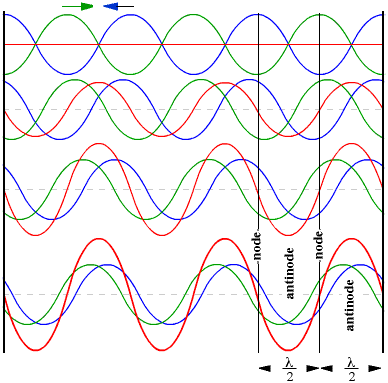
When two waves with equal frequency and magnitude travel in opposite directions they create standing waves. Below is a figure with several snapshots with a green wave traveling left and a blue wave traveling to the right, where the red line is the sum of the two traveling waves. As the waves propogate they add in a such a way to produce a standing wave.
Mathematical
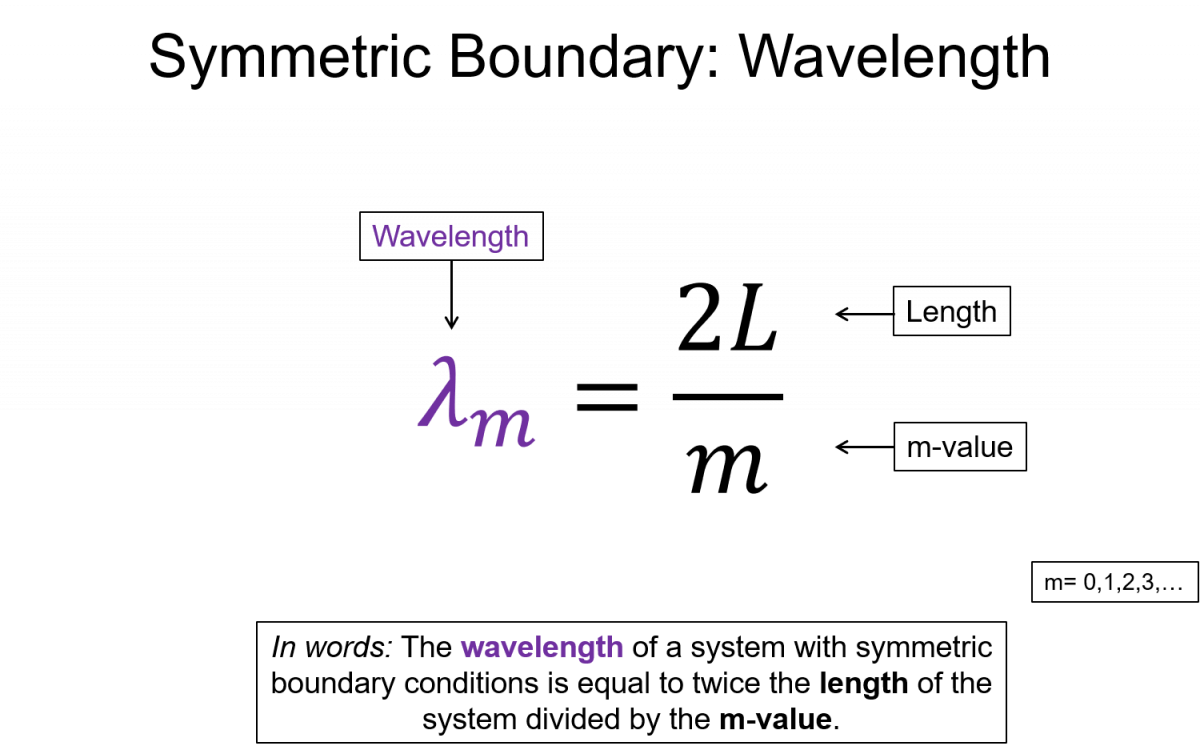
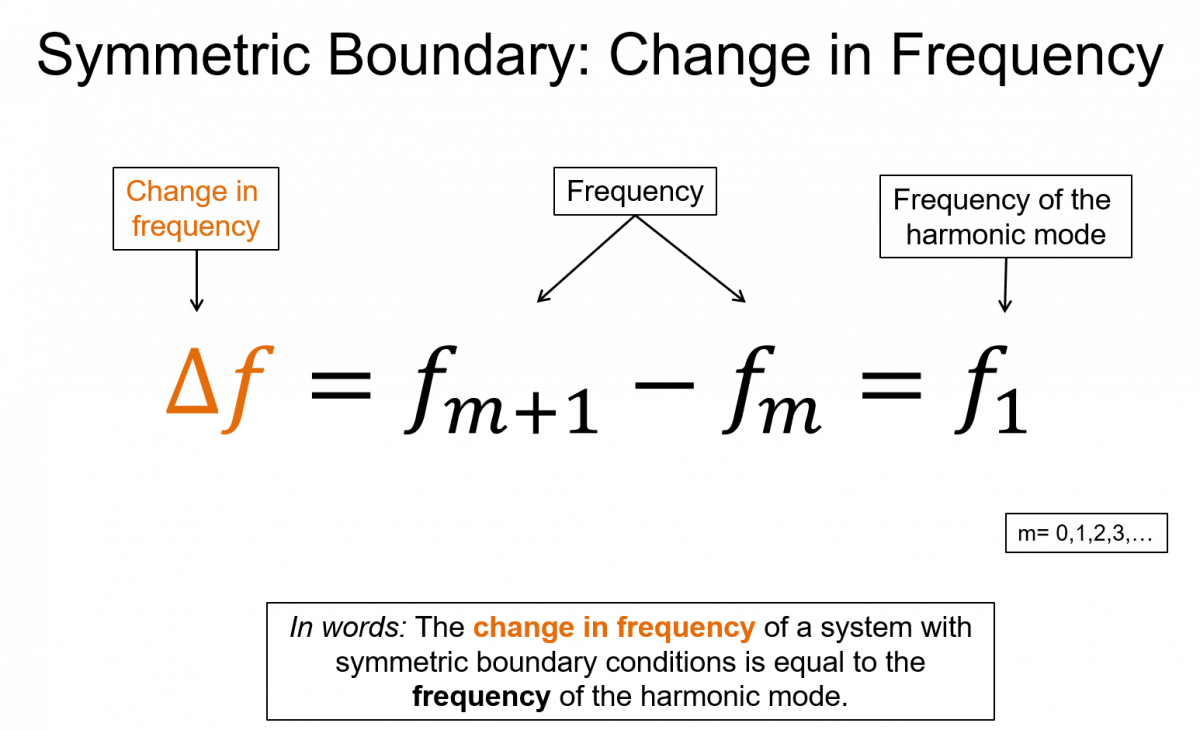
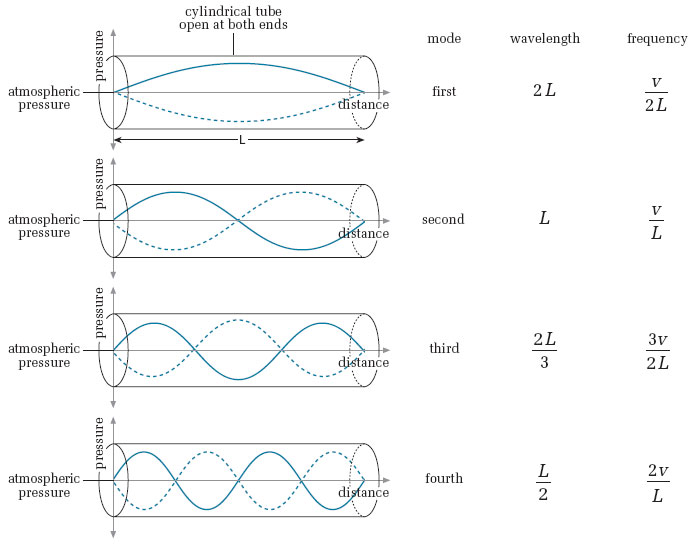
Symetric boundary conditions,
$\lambda_m = \frac{2L}{m}, m = 1,2,3,4,5,...$
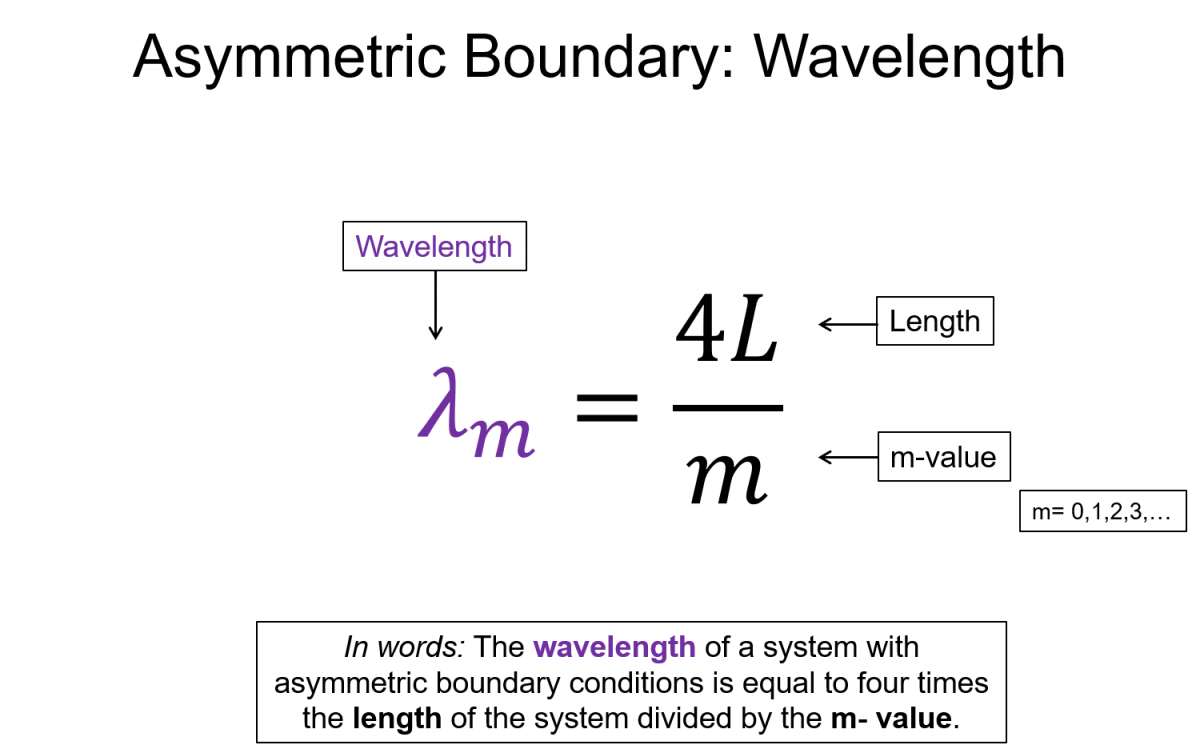
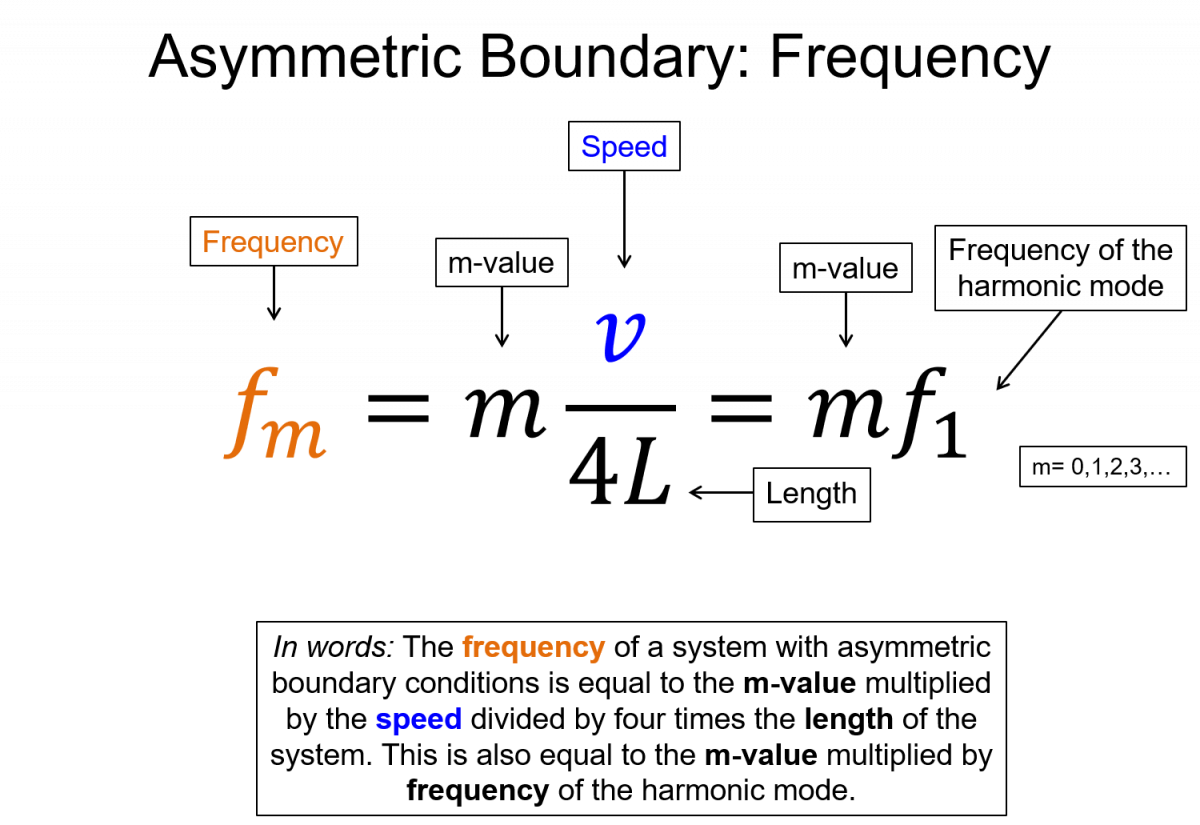
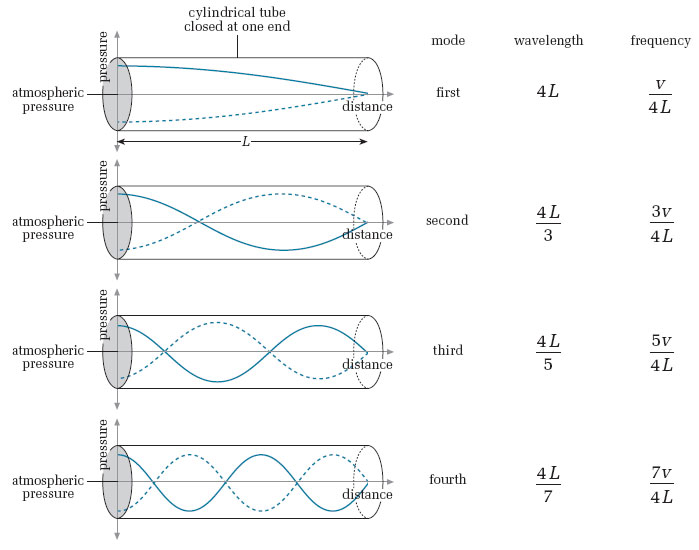
Antisymetric boundary conditions,
$\lambda_m = \frac{4L}{m}, m = 1,3,5,7,9,...$
$f_{m} = \frac{\nu}{\lambda_{m}}$
Wavelength ($\lambda$), Velocity ($\nu$), Integer ($m$)


Graphical
Symetric boundary conditions.
Antisymetric boundary conditions
Descriptive
Standing waves are created by waves with the same frequency, wavelength, and ideally amplitude which are traveling in opposite directions. They add in such a way that it looks like the wave is just occilating up and down. However, the waves are still moving back and forth, but the contructive and destuctive interference of the two waves occur at fixed positions relative to the geometry of the system.
Experimental
Attach a rope so that one end is fixed, or have two people at each end of a rope. Now, move you hand up and down and find the correct frequency oscillation of your hand to create a standing wave. In the following video observe the motion of the persons hand as he creates several resonant standing waves. The first 2 minutes is important, otherwise please ignore the commentary as they use terminology that is not recommended.
 |