Ideal Gas Law: Tips & Tricks
Ideal Gas Law: Tips & Tricks
Problem Solving Guide
Algorithm
1. Proportional reasoning using the ideal gas law $PV=nRT$
2. Unit conversion
3. Relating changes in the thermodynamic variables in the ideal gas law to changes in the thermal energy $E_{th}$ of the system.
1. Identify which of the 3 tasks the problem is asking you to do (often the answer is all 3 of them). Proportional reasoning is something you should already be familiar with; employ your favorite tactic. If you are struggling with proportional reasoning, show up to office hours and ask a TA for help as soon as possible, they'll be happy to help!
2. For unit conversions, just take your time and make sure you have the correct definitions down. If you aren't sure, for example, how to convert $1 m^2$ into $cm$, just write it out: $1 m^2 = (1 m)(1 m) = (10^{-2} cm)(10^{-2} cm) = 10^{-4} cm$ which makes things more clear than trying to jump from $1 m^2 = 10^{-4} cm$
3. THREE
Misconceptions & Mistakes
The ideal gas law is an approximation. There is no such thing as an ideal gas (although some types of particles, such as noble gasses, come close). But it is a very good approximation for most particles, especially at standard temperature and pressure.
Pro Tips
- $Nk_{B} = nR$.
- Always convert temperatures to Kelvin. At the end of the problem you might be asked to report the answer in other units, but whenever you use the ideal gas law to make calculations you'll need to use temperatures in Kelvin, so you may as well be in the habit of converting right away so you don't make a calculator mistake.
- For lots of ideal gas problems, the trick is reading the problem carefully. You'll often be explicitly given the value of one thermodynamic variable, then something about the way the question is phrased should lead you to assume one of the other thermodynamic variables is constant. The problem then reduces to just doing algebra to solve for one of the variables in the Ideal Gas Law.
- Liters go with atmospheres; meters go with pascals. A helpful mnemonic is to remember that pascals are defined as a newton of force applied over a meter squared area, which gives you a pascal: $P = \frac{F}{N} = \frac{N}{m^2} = Pascals$. So meters and pascals are naturally associated in that way.
-
Even if they are packaged differently, most problems in this question are best solved with proportional reasoning. Nearly every problem has some form of a couple thermodynamic variables staying constant and another changing, and asking what happens to the remaining ones (e.g. $P$ and $N$ are constant but $V$ increases; how does $T$ change?).
Multiple Representations
Multiple Representations is the concept that a physical phenomena can be expressed in different ways.
Physical
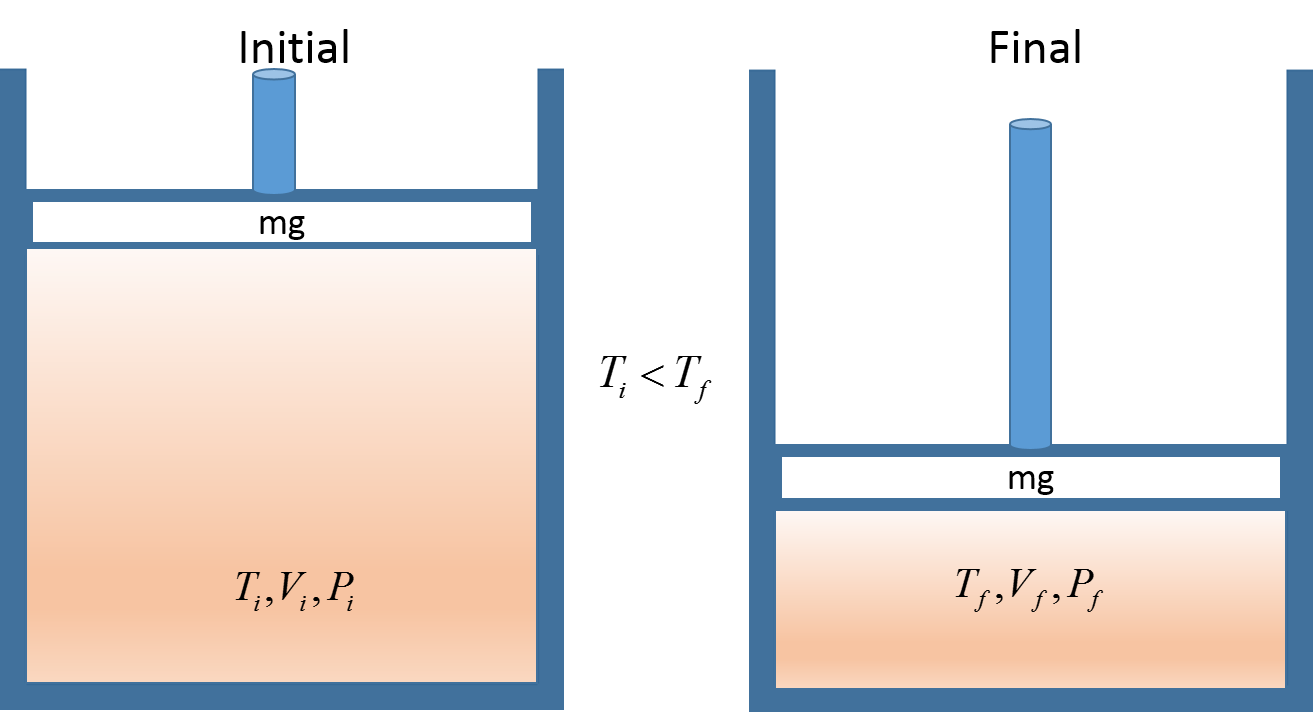
The initial and final states of two pistons where the pressure increases from intial to final thus increasing the final temperature. This is one physical representation we might use to solve an ideal gas law problem.
Mathematical
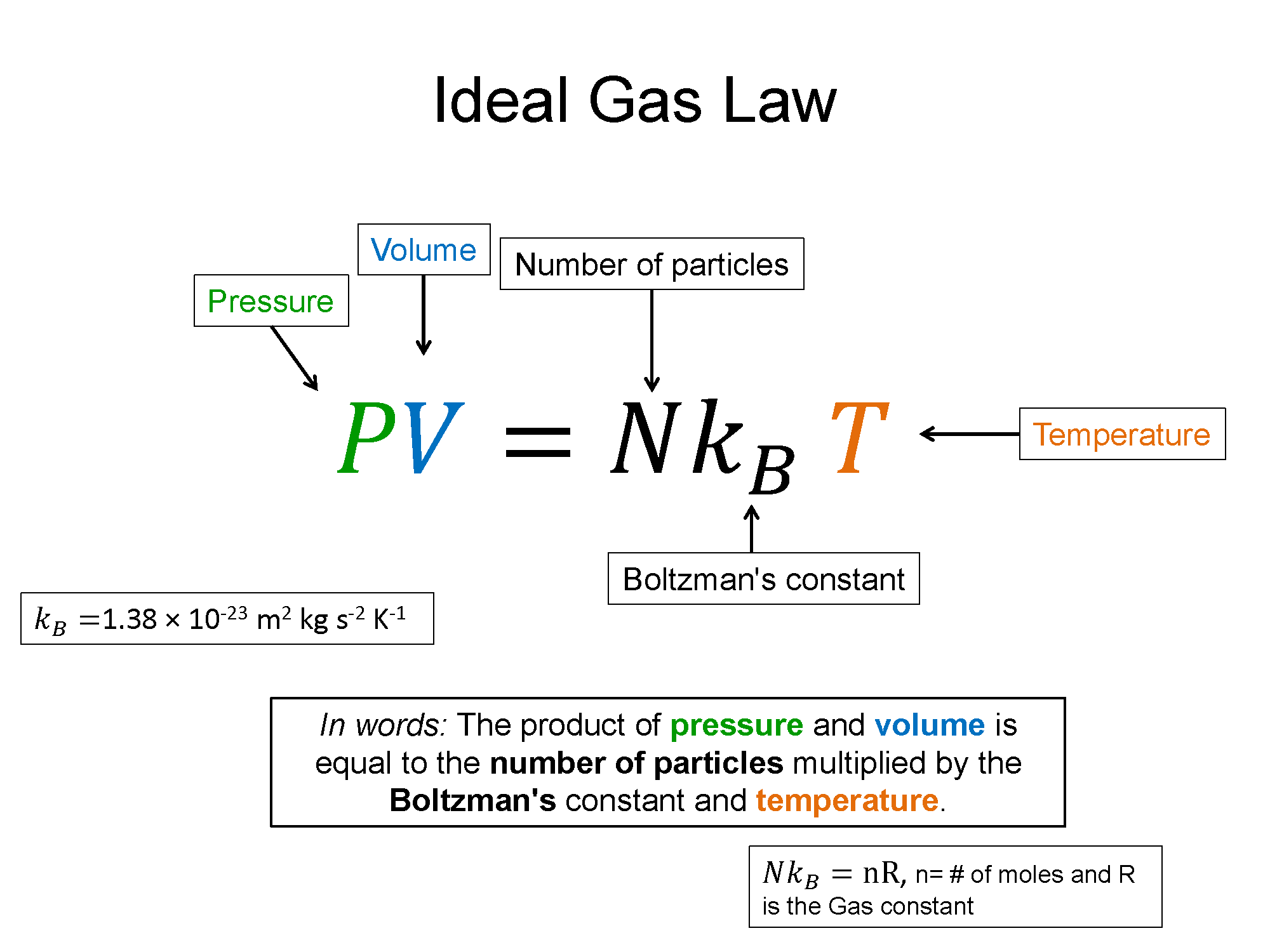
$PV=nRT = N K_b T$
Pressure ($P$), Volume ($V$), Numer of mols ($n$), Rydberg constant ($R$), Temperature ($T$), Numer of particles ($N$),
Boltzman constant ($K_{b}$)
Graphical
The following plot describes how the pressure and volume of a system respond to the state of the system temperature.

Descriptive
The ideal gas law describes the relationship between pressure (P), volume (V), and temperature (T). Namely, pressure and volume are inversely proportional to each other when the temperature is held constant. In addition, there is a direct relationship between pressure and temperature when the volume is held constant, or conversely there is a direct relationship between volume and temperature when the pressure is held constant.
Experimental
The ideal gas law was derived from three different laws: Boyle's law, Charle's law, and Avogadro's law. The following three videos give some insight into each law separately.
Boyle's law
Charle's law
Avogadro's law
 |