Ideal Gas Law: Fundamentals
Ideal Gas Law: Fundamentals
BoxSand's Resources
Introduction
The Ideal Gas Law was first understand empirically through experimentation. It relates the thermodynamic state variables of temperature (T), pressure (P), volume (V), and number of particles (N). Since it is an equation comprised of variables that describe the state of the system, it is call an equation of state. Theoretically if a gas is truly ideal, that means the particles in the gas do not interact. There are other equations of state for gases that do not behave ideally. The ideal gas equation in physics is typically written as follows.
$PV=Nk_B T$, where kB is Boltzman's constant
Alternatively there is a form more typically seen in chemistry of $PV=nRT$. Here n represents the number of moles of particles in the gas and R is the Rydberg constant. Either form is valid and which one you use depends on what information is given. Either Way, since they are equivalent forms, then that must mean that $Nk_B = nR$, a useful relationship in other topics of thermo such as the kinetic theory of gases.
The graph is a 3D depiction of the ideal gas relationship with projections onto 2D surfaces.
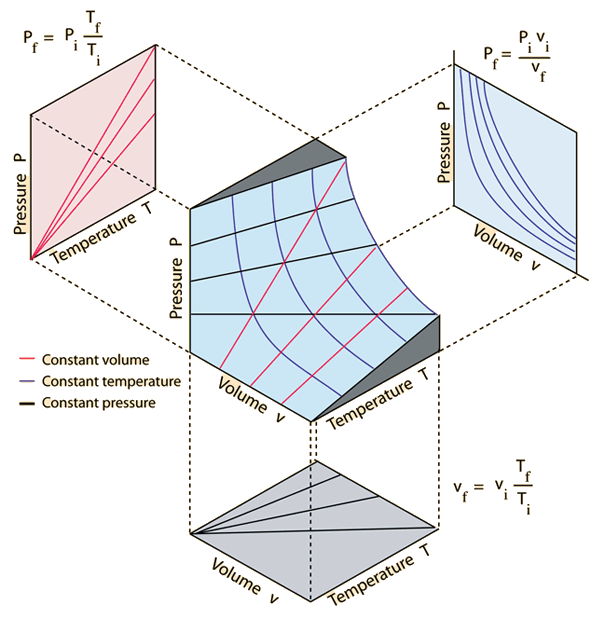
*Graphic by Hyperphysics
Videos
Pre-Lecture Videos
Watch these videos before doing the pre-lecture assignment. (**denotes supplementary but suggested)
Thermoequilibrium(6min)
Thermo equations of state(3min)
Thermo equations of state - non-ideal(2min) **
Thermo equations of state - ideal gas law(5min)
Thermo equations of state - ideal gas law - empirically derived (9min) **
Thermo ideal gas simple example(2min) **
Web Resources
Text
This link takes you to the Openstax chapter on the Ideal Gas Law

Hyperphysics provides us with an interactive concept map for the Ideal Gas Law. All these bubbles will be relevent throughout the section, start at the top with "Ideal Gas Law"
Boston University's page on the ideal gas law is a quick read,

Other Resources
This link will take you to the repository of other content related resources.

Videos
The Pre-Med Academy introduces the ideal gas law in a straight forward way.
Professor Dave Explains the ideal gas law in a very clear manner. At the end of the video he will stop for a concept check. This is a good opportunity for practice! Pause the video and give the problems a try before he gives the answers.
Doc Schuster gives a good introduction to the Ideal Gas Law.
Crash Course has a strategy video for solving Ideal Gas Law problems.
Tyler DeWitt works through some ideal gas problems.
Other Resources
This link will take you to the repository of other content related resources.
Simulations
Here is the PhET Simulation for exploring gas properties. While using the app, think about how the Ideal Gas Law can be used to describe what is happening. Even consider a situation first using the Ideal Gas Law, then try to confirm your predictions using the simulation.

This simulation brings together the ideal gas law in a fun easy way to understand.

For additional simulations on this subject, visit the simulations repository.

Demos
Here are several demonstrations with the ideal gas law.
For additional demos involving this subject, visit the demo repository

Practice
Fundamental examples
1. An ideal gas is sitting inside a container. (a) If the temperature of the gas is constant and the pressure of the gas quadruples, how does the volume change? (b) If the volume triples and the temperature is halved, what happens to the pressure?
2. 10 mol of helium are in a 15 L cylinder. The pressure gauge on the cylinder reads 65 psi. (a) What is the temperature of the gas in celsius? (b) What is the average kinetic energy of a helium atom?
3. A container holds an ideal gas at 20 degrees Celsius. The gas is composed of $10^{24}$ monatomic particles. (a) 1000J of thermal energy is added to the gas. What is the new temperature of the gas? (b) If, instead, the container holding the ideal gas expands to be double its original size and the pressure remains constant, what is the final temperature of the gas?
Short foundation building questions, often used as clicker questions, can be found in the clicker questions repository for this subject.

Practice Problems
BoxSand's multiple select problems
BoxSand's quantitative problems
Recommended example practice problems
- Openstax, many examples throughout, 3 conceptual questions, and 17 practice problems, Website Link
-
Good Worksheet of 5 questions pertaining to the Ideal Gas Law, PDF Link
-
8 problem worksheet on Gas Laws. PDF Link.
For additional practice problems and worked examples, visit the link below. If you've found example problems that you've used please help us out and submit them to the student contributed content section.


 |
 |