Conservation of Energy: Nuts & Bolts
Conservation of Energy: Nuts & Bolts
3. Nuts & Bolts
Algorithm
Expand
1. Read and re-read the whole problem carefully.
2. Visualize the scenario. Mentally try to understand what the object(s) are doing and what forces are acting on them.
3. Identify the system you wish to analyze; This may include one or more objects if coupled to one another.
4. Write down all of your knowns and unknowns.
5. Identify all the forces acting on your object(s). Include a FBD to help keep track of the forces.
6. Ask yourself the following questions:
a. Do your object(s) change height?
i. If so, include gravitational potential energy.
ii. Define a zero potential energy location, usually at the lowest location the object reaches.
b. Is there a spring involved in the scenario?
i. If so, include spring potential energy.
c. Are there any non-conservative forces acting on the object(s)?
i. If so, calculate the work done by each non-conservative force.
ii. Draw vector operations to help determine the angle between the non-conservative force and
displacement.
7. Determine the equilibrium position of the spring, and make sure you use displacements from that equilibrium position in the spring potential energy function.
8. Determine if there are any non-conservative forces acting on the object(s)
9. Use conservation of energy $K_i + U^G_i +U^S_i + \sum W_{nc} = K_f + U^G_f +U^S_f $ to solve for relevant quantities.
10. Evaluate your answer, make sure units are correct and the results are within reason.
Multiple Representations
| Multiple Representations is the idea that a physical phenomena can be explored in many different ways. For example, there is the physical representation which models the system with figures and diagrams, such as a free body diagram. There is also the mathematical representation which uses the equation(s) governing the physics of the system. All of the representations can be used together to help us understand and quantify the physical phenomena. |
Observe the different types of representations for this section below:
Physical Representation
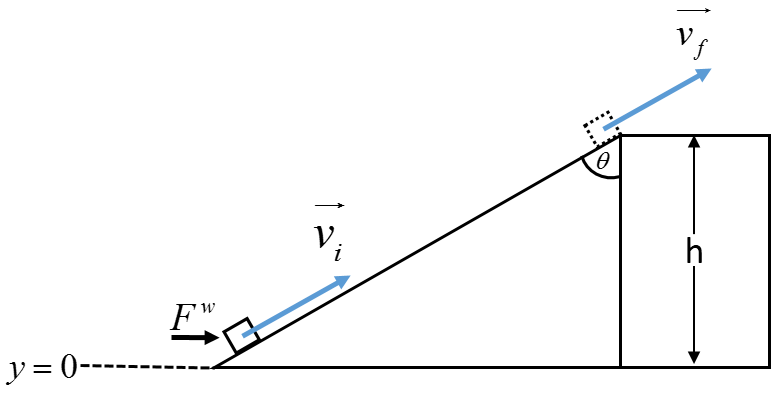
A block is launched up a frictionless ramp with initial velocity $\vec{v_{i}}$.
Mathematical Representation
$ \sum K_{i} + \sum W_{external} = \sum K_{f}$
$ K = \frac{1}{2} mv^{2}$
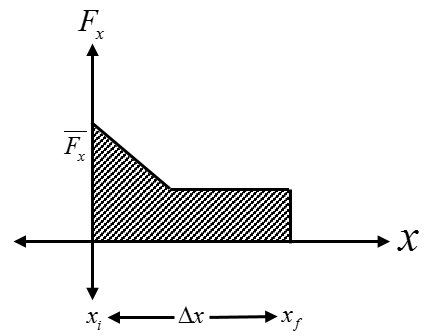
$W = \bar{\vec{F}_{ext}} \cdot \Delta \vec{r}$
Graphical Representation
.
Descriptive Representation
A block is launched up a frictionless ramp, as shown in physical representation above, with an initial $\vec{v_{i}}$. The block travels up the ramp and continues across the level section. Once the block has been launched up the ramp, force due to gravity and the normal force will act upon the block. The force due to gravity will slow the box down, so gravity will do non-zero work on the block, while the normal force will do zero work on the block. If friction was present, then friction would also be doing work on the block and decelerate the block.
Actual Phenomena
Example Problems
Set 1:Multiple choice problems 25,26 PDF
Set 2: UoW-Greenbay: Stopping distance of a roller coaster, Ball Launched with spring,
Set 3: Physics.info set for Conservation of Energy, Website
For additional practice problems and worked examples, visit the link below.