Standing Wave Resonance: Nuts & Bolts
Standing Wave Resonance: Nuts & Bolts
3. Nuts & Bolts
Algorithm
Expand
Multiple Representations
| Multiple Representations is the idea that a physical phenomena can be explored in many different ways. For example, there is the physical representation which models the system with figures and diagrams, such as a free body diagram. There is also the mathematical representation which uses the equation(s) governing the physics of the system. All of the representations can be used together to help us understand and quantify the physical phenomena. |
Observe the different types of representations for this section below:
Physical Representation
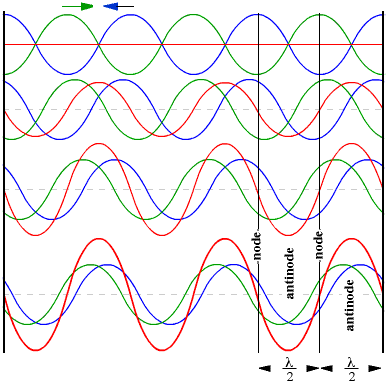
When two waves with equal frequency and magnitude travel in opposite directions they create standing waves. Below is a figure with several snapshots with a green wave traveling left and a blue wave traveling to the right, where the red line is the sum of the two traveling waves. As the waves propogate they add in a such a way to produce a standing wave.
Mathematical Representation
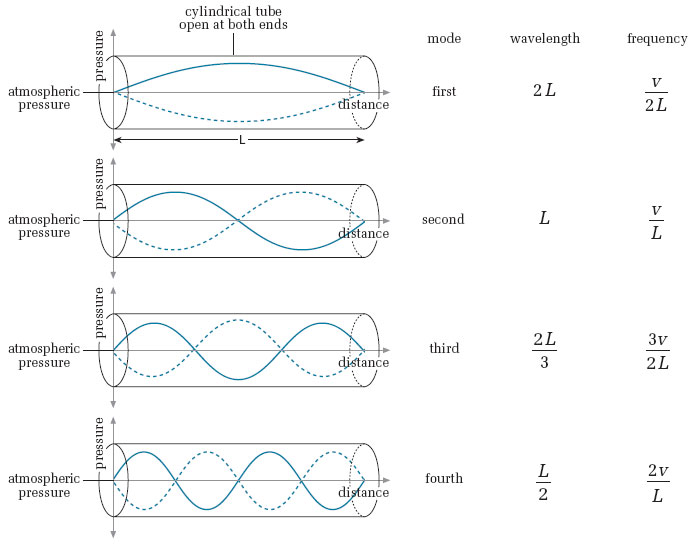
Symetric boundary conditions,
$\lambda_m = \frac{2L}{m}, m = 1,2,3,4,5,...$
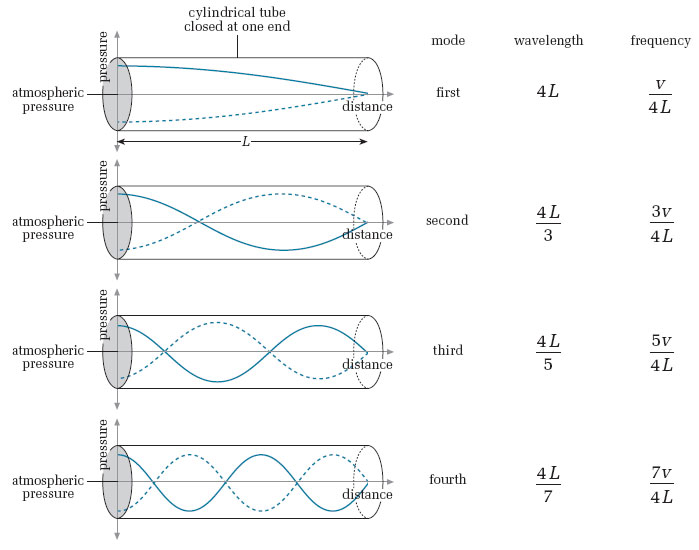
Antisymetric boundary conditions,
$\lambda_m = \frac{4L}{m}, m = 1,3,5,7,9,...$
$f_{m} = \frac{\nu}{\lambda_{m}}$
Wavelength ($\lambda$), Velocity ($\nu$), Integer ($m$)
Graphical Representation
Symetric boundary conditions.
Antisymetric boundary conditions
Descriptive Representation
Standing waves are created by waves with the same frequency, wavelength, and ideally amplitude which are traveling in opposite directions. They add in such a way that it looks like the wave is just occilating up and down. However, the waves are still moving back and forth, but the contructive and destuctive interference of the two waves occur at fixed positions relative to the geometry of the system.
Experimental Representation
Attach a rope so that one end is fixed, or have two people at each end of a rope. Now, move you hand up and down and find the correct frequency oscillation of your hand to create a standing wave. In the following video observe the motion of the persons hand as he creates several resonant standing waves. The first 2 minutes is important, otherwise please ignore the commentary as they use terminology that is not recommended.
Example Problems
- Openstax has a few practice problems for standing wave resonance, Link
For additional practice problems and worked examples, visit the link below.