Multiple Representations Momentum
Multiple Representations Momentum
Multiple Representations
| Multiple Representations is the idea that a physical phenomena can be explored in many different ways. For example, there is the physical representation which models the system with figures and diagrams, such as a free body diagram. There is also the mathematical representation which uses the equation(s) governing the physics of the system. All of the representations can be used together to help us understand and quantify the physical phenomena. |
Observe the different types of representations for this section below;
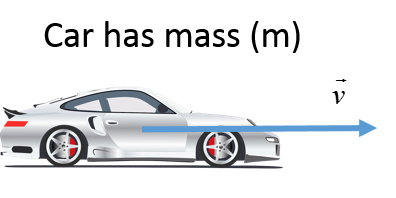
Below we can see a car of mass (m) with some 1D velocity moving horizontally to the right.
Here, an object with mass (m) is moving with 2D motion and therefore has both vertical and horizontal velocity components.


Momentum = mass * velocity
Remember that momentum is a vector quantity comprised of a velocity vector multiplied by a scalar mass quantity.
$\vec{p} = m \vec{v}$
As shown in the mathematical representation for momentum, the only way the momentum of an obejct may change is either by changing the mass or the velocity. Here we have a force vs time graph. Force is related to velocity through accleration, recall Newton's Second Law. Therefore, we may analyze a force vs time graph to determine the change in momentum of an object with respect to time.
. 
Lets analyze a rocket launch. At time $t1$ our rocket has some initial mass $m_{1}$ and an initial velocity $\vec{v}_{1}$, giving it a momentum of $\vec{p}_{t1} = m_{1} \vec{v}_{1}$. After some later time $t2$, the rocket has used up some fuel and the mass of the rocket has changed to $m_{2}$, while the velocity has not changed, giving the rocket a differnt momentum of $\vec{p}_{t2} = m_{2} \vec{v}_{1}$.
While you are driving your momentum is mostly dependent on the velocity of your vehicle. Any change in mass of the vehicle and the passengers is negligible, and we may treat the mass as constant. Therefore, as you are driving you can measure your momentum by multiplying the mass of the car plus the passengers with the value of your speedometer.