Free Body Diagrams: Nuts & Bolts
Free Body Diagrams: Nuts & Bolts
3. Nuts & Bolts
Algorithm
Expand
Other Algorithm Resources
Here is a 4 step process to setup FBDs:

Multiple Representations
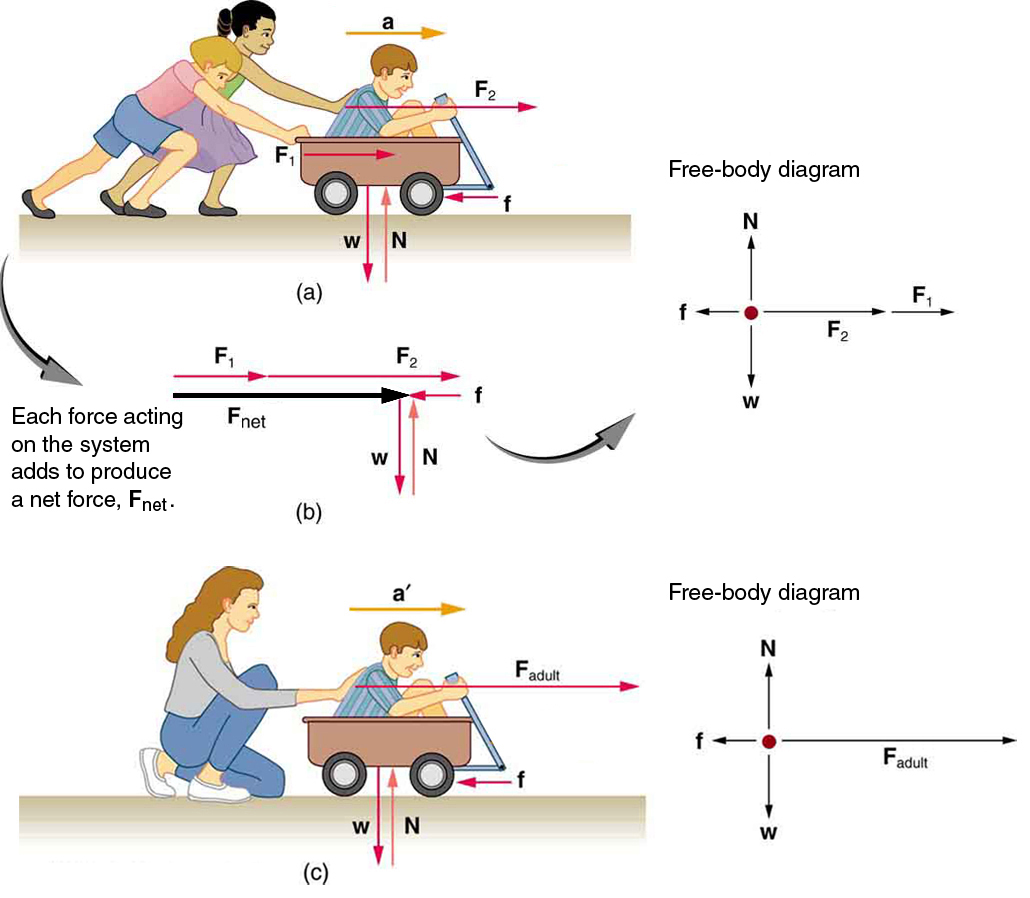
| Multiple Representations is the idea that a physical phenomena can be explored in many different ways. For example, there is the physical representation which models the system with figures and diagrams, such as a free body diagram. There is also the mathematical representation which uses the equation(s) governing the physics of the system. All of the representations can be used together to help us understand and quantify the physical phenomena. |
Observe the different types of representations for this section below:
Physical Representation

Mathematical Representation
The main mathematical representation for forces will be applying Newton's Second Law to a physical problem. You will need to analyze the motion of an object and create a free body diagram of the relative forces in order to derive the force equations. We learned in the kinematics section how to analyze motion without any concern about the forces that caused the motion. The infographic below describes the relationship between force and accelertion. Thus, we may now analyze the forces acting on an object to determine the relative acceleration.

Page 3 of this site does a wonderful job of showing many of the different mathematical representations.
Graphical Representation
Descriptive Representation
This can be thought of as a word problem. For example, “If Steve pushes a one kilogram box for twelve seconds, and it goes five feet, how hard did Steve push?” would be a descriptive representation of a problem where you would have to translate a FBD into Newton's second law.
Actual Phenomena
Here is a video that descibes an actual situation with FBD techniques applied
Example Problems
Set 1: Net Force and Newton's Laws of Motion
Set 2: Drawing Free Body Diagrams
For additional practice and worked examples, visit the repository.