Friction: Tips and Tricks
Friction: Tips and Tricks
Problem Solving Guide
Algorithm
Misconceptions & Mistakes
- The coefficient of friction has no units.
- A single object does not have a coefficient of friction. The force of friction exists between two surfaces, so the coefficient of friction arises from the interaction of the materials.
- Friction is always parallel to the surface interaction of the two objects.
- Along this same lines many people think that friction is never in the same direction as the velocity. Consider the situation below and assume box 2 does not slip relative to box 1 and that the applied force causes them to both move to the right. The only horizontal force on box 2 is friction, therefore the friction must be in the same direction as the motion of box 2.

- The coefficient of friction can be greater than one.
- The biggest misconception about friction is that it opposes the motion of an object. This is not always true; friction arises from the contact between two surfaces. Friction opposes the relative motion of these two surfaces. This can be a subtle, and confusing, distinction. What relative motion describes is how two objects are moving compared to each other, not the motion from an outside observer. A good example of this is a box on the back of a pickup truck when the truck, starting from rest, puts the pedal to the metal and the box slides off the truck. If I’m watching the truck drive away I see the truck drive to right while the box in the back slips off, staying where it was. However, I’m an outside observer. For the relative motion of the box and the truck I need to ask how the truck driver sees the box move. If I’m the truck drive I don’t see the truck and I moving right, I see the box sliding to the left. That is the relative motion of the box and the trucks.
- There are also two type of friction, static and kinetic friction. Sometimes people will include both of these forces from a single object. These two forces are never applied at the same time by the same object. If the system has two objects touching it, such as box 1 above, it can have static friction with box 1 and kinetic friction with the table. However, there will never be static and kinetic friction from box 1.
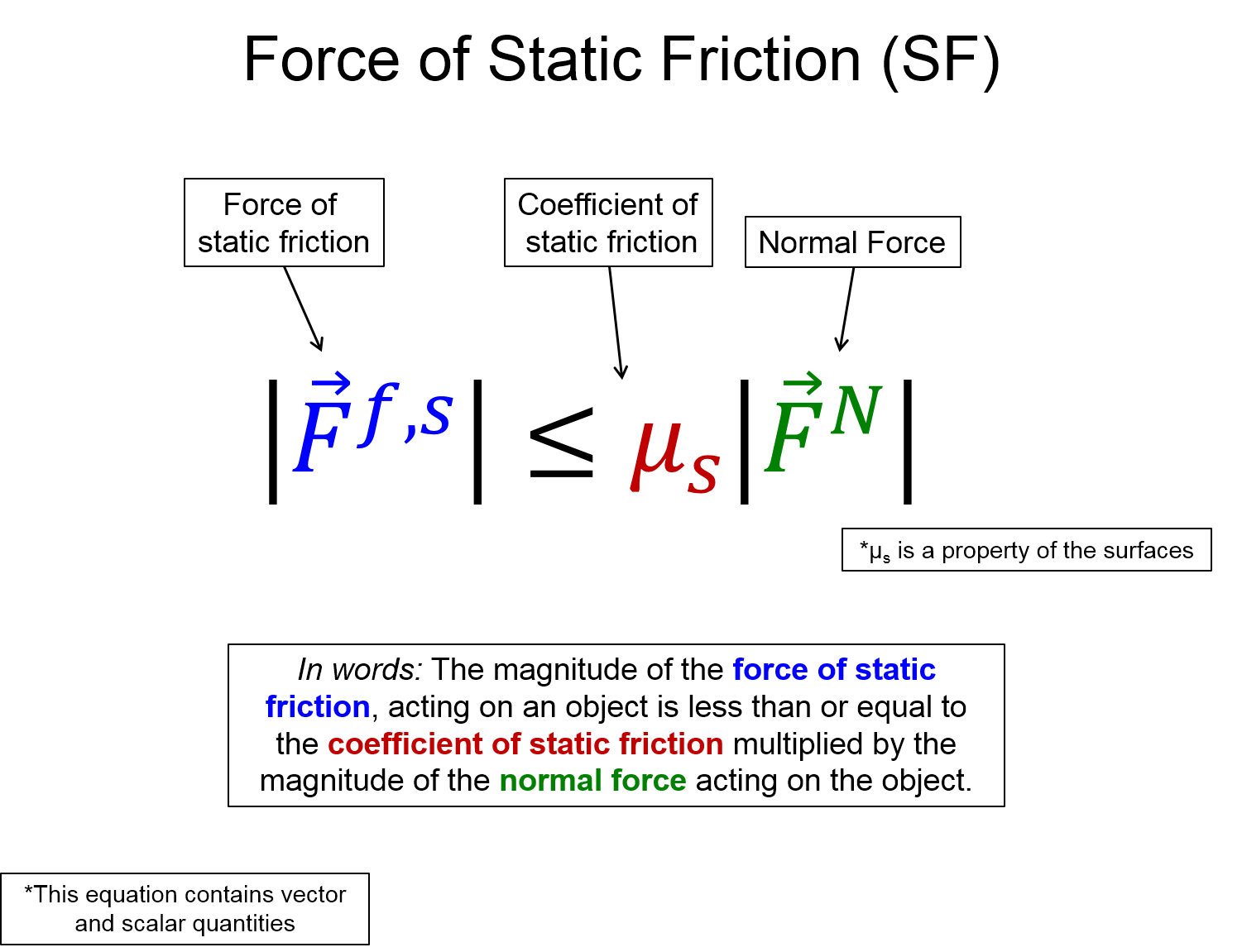
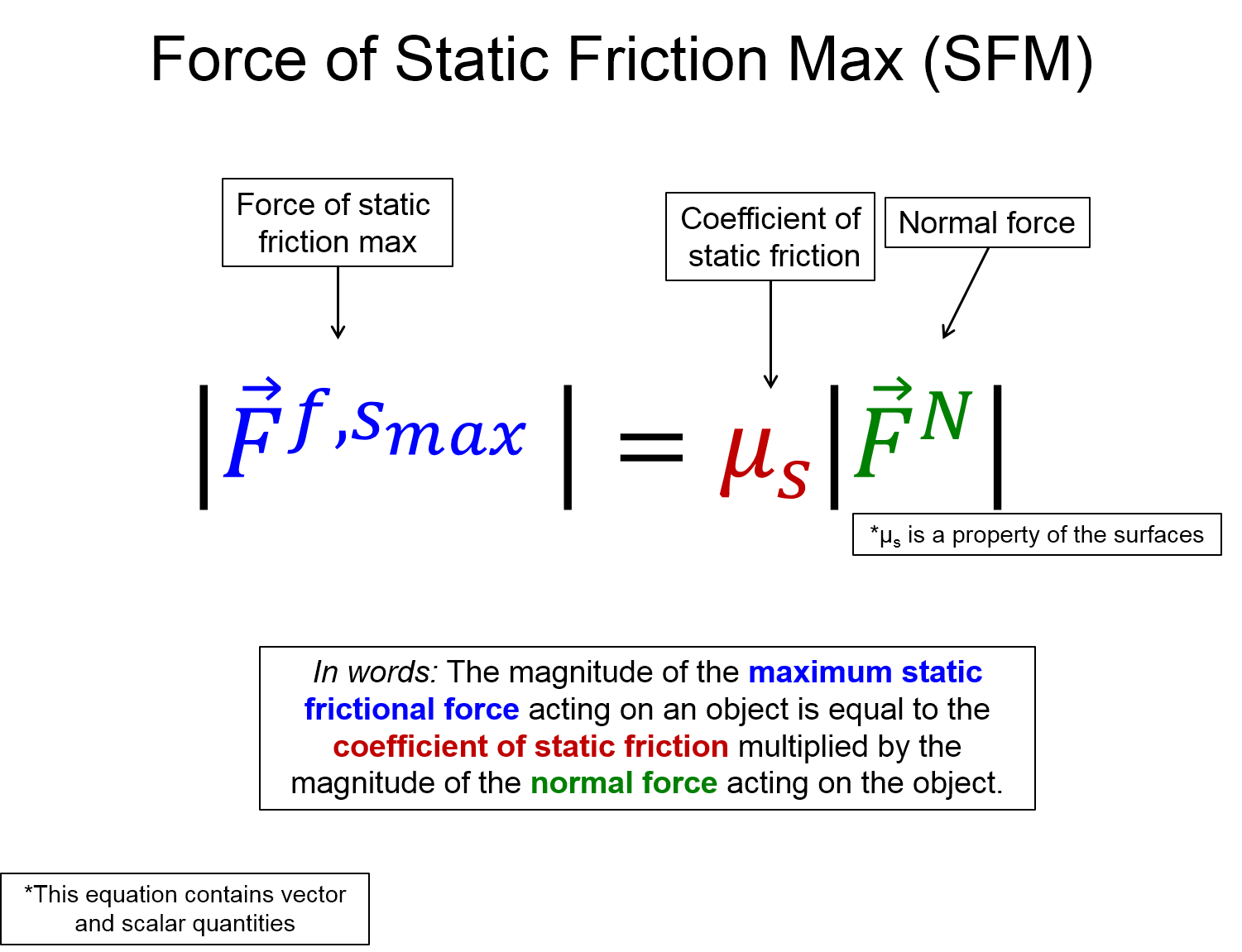
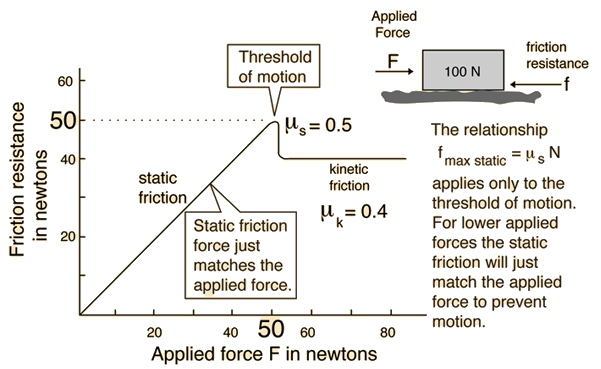
- The equation $ \left| \vec{F}^{f_s,max} \right| = \mu_s \left| \vec{F}^N \right| $ can only be used when an object begins to first move or slip. The common misconception is that $ \left| \vec{F}^{f_s} \right| $ is always equal to $ \mu_s \left| \vec{F}^N \right| $. This is only the case for $ \left| \vec{F}^{f_s,max} \right| $ ; the largest value allowable before the object begins to move relative to the surface it is in contact with.
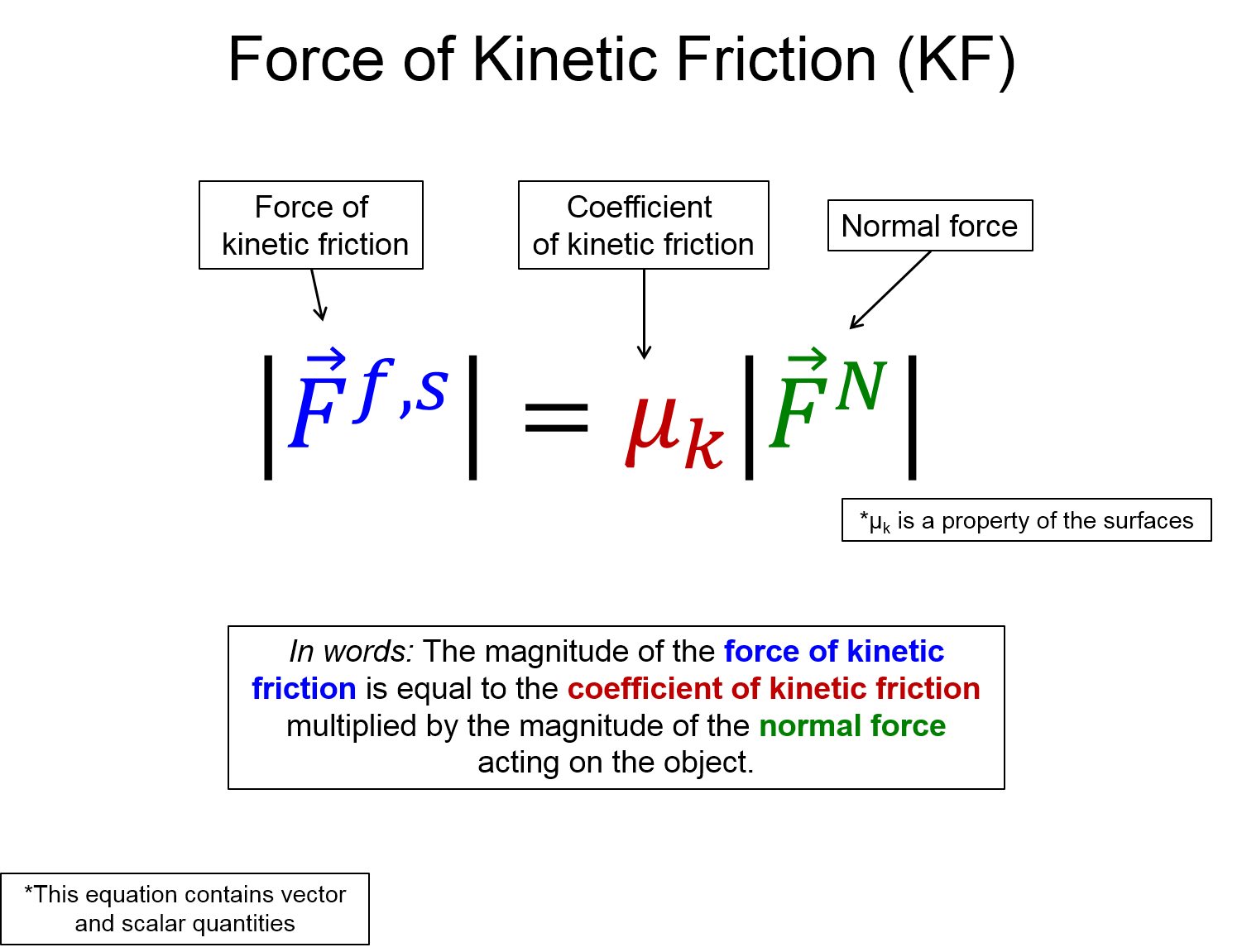
- We will be making the approximation that the force of kinetic friction does not depend on the speed of the relative motion.
- The force of kinetic friction we deal with is not the same as the force of rolling friction.
- You only have a normal force from a solid surface onto another object (and vice versa) and it is always pushing perpendicular to their contact. (also you always have a normal force when 2 objects are touching).
- Remember that unless explicitly stated gravity is always acting directly downward on the object
Pro Tips
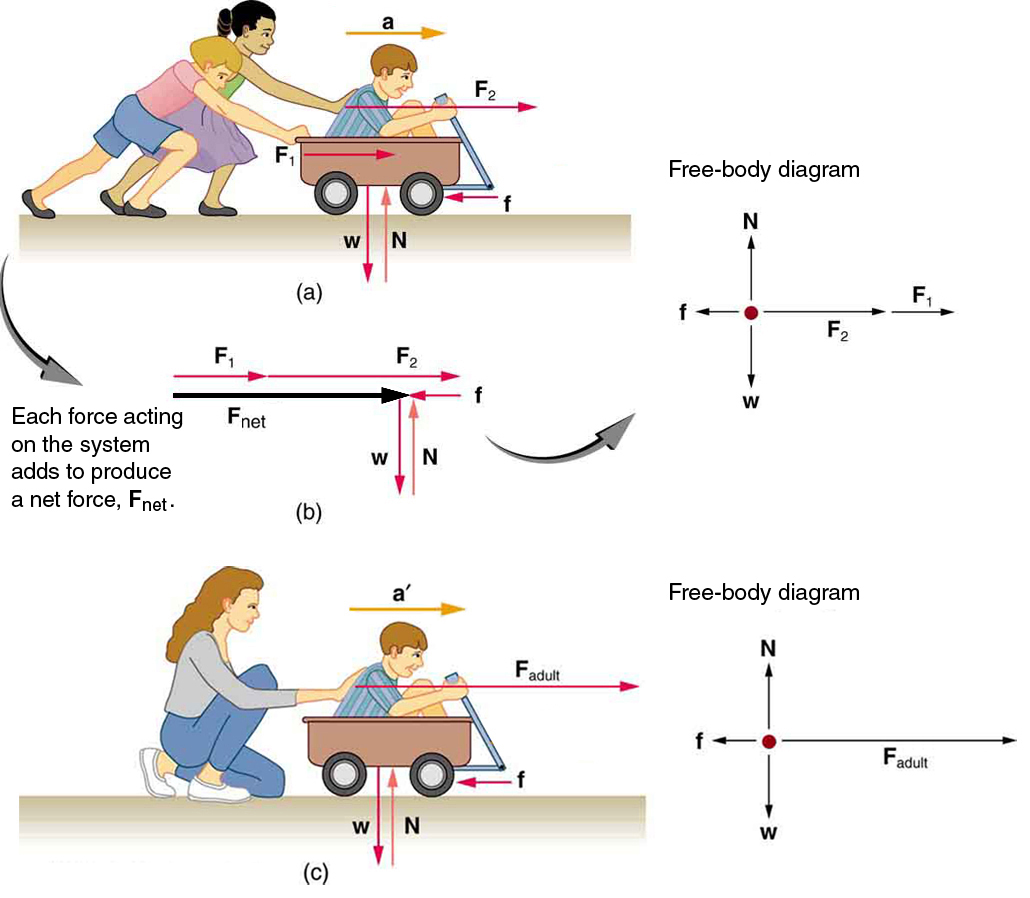
- To help determine the direction of the force of friction, imagine the same system but now with no friction between the two surfaces in question. Then see if there are any net forces remaining that would cause the object to move relative to the other surface that it is in contact with. If so, friction would then oppose that relative motion.
- Another way to help determine the direction of friction, is to draw all other forces on your free body diagram first. Then based on the information given in the problem, draw the force of friction vector to ensure that the free body diagram reflects the proper motion expected. *NOTE: This can not always be done if the problem does not have enough information to determine the direction of relative motion.
- When drawing a free body diagram for different masses remember that the direction of friction differs depending on which mass you are drawing it for- think about the net forces on that mass. *NOTE: The same frictional force on two different masses will not go in the same direction.
- Remember friction is a force between two surfaces, thus if there is a frictional force between 2 objects there must also be a normal force between the objects as well. *NOTE: The normal force will be perpendicular to the surface while the frictional force will be parallel to it.
Multiple Representations
Multiple Representations is the concept that a physical phenomena can be expressed in different ways.
Physical
Mathematical
Example video relates FBD friction vectors to math relationship.
Graphical

Descriptive

Hyper Physics static friction
Experimental
We could go out and physically push a $17 \; kg$ crate on a mostly frictionless surface and measure the average distance we travel for some period of time. By measuring the average distanced traveled per unit time, we can determine the acceleration by determining the slope of a velocity versus time graph. This would allow us to use Newton's Second Law and relate the force to acceleration.
 |