Hydrostatics: Tips & Tricks
Hydrostatics: Tips & Tricks
Problem Solving Guide
Algorithm
1. Read and re-read the whole problem carefully.
2. Visualize the scenario. Mentally try to understand what the problem is asking (think about the geometry, such as circles, rectangles, etc... that the problem might be asking about).
3. Draw a physical representation of the scenario, this may include a picture of an object with labeled dimensions and forces.
4. Identify all the knowns and unknowns.
5. Label locations of equal pressure (horizontal lines).
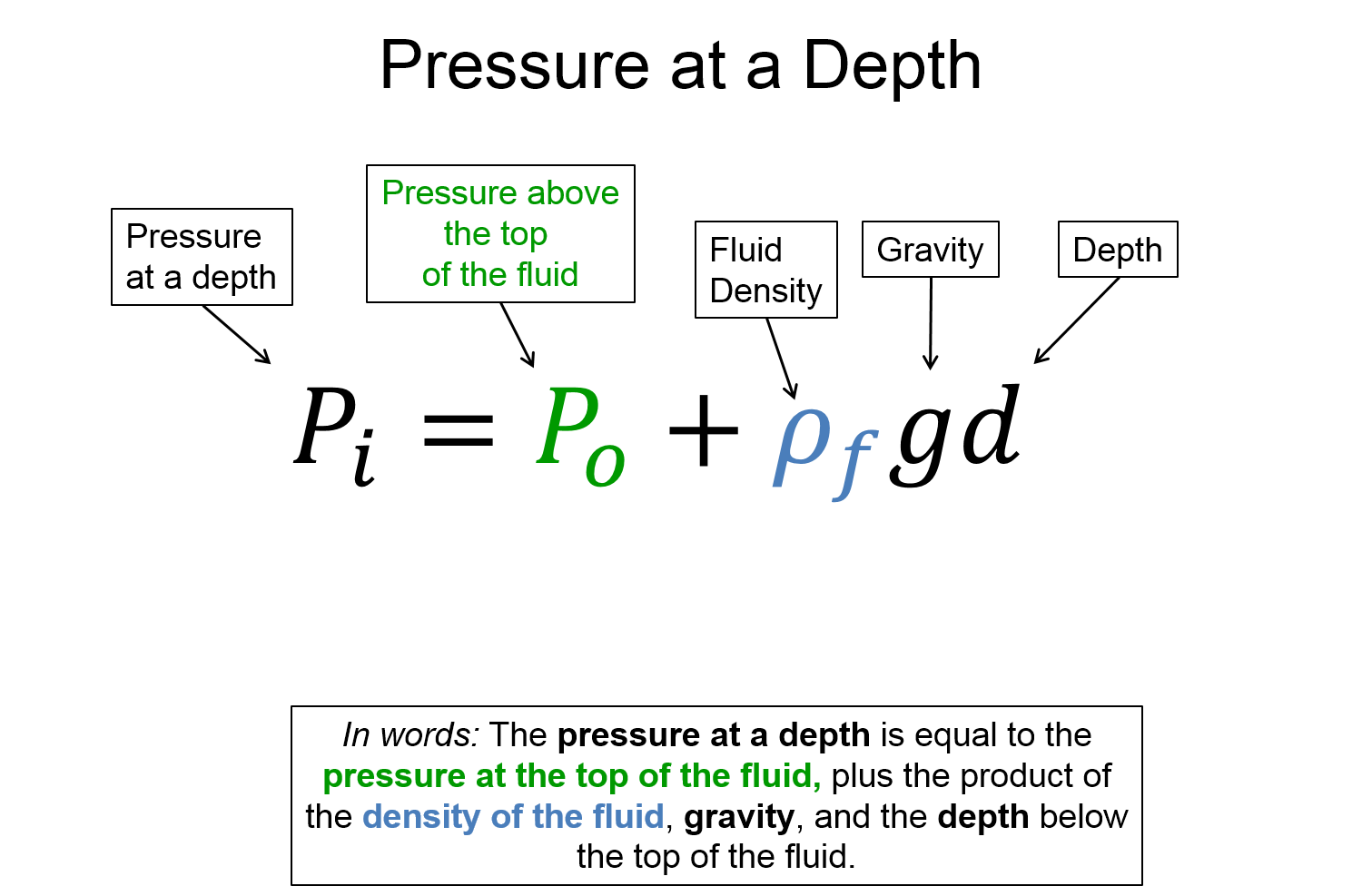
6. Construct a pressure at a depth equation for locations of interest. ( $P_1 = P_0 + \rho_{f} \, g\, d$ )
a. Identify which quantities you know and don't know.
b. Use the geometry of the object and subsitute the definition of area for that specific shape if necessary.
7. Carry out the algebraic process of solving the equation.
8. Evaluate your answer, make sure the units are correct and the results are within reason.
Misconceptions & Mistakes
- The pressure at the bottom of a fluid does not depend on the shape of the container (i.e. it does not depend on the area or volume). The pressure only depends on the depth below the surface, the density of the fluid, and the acceleration due to gravity. For example, the pressure at locations $A$ , $B$, and $C$ in the figure below are all the same since they are all the same distance below the surface. Likewise, all locations within the fluids along the dashed red line have the same pressure (same pressure but not the same pressure as the bottom).

- Pressure at a depth equation is only valid for incompressible fluids.
- Pascal's Law is only valid for incompressible fluids.
Pro Tips
- Draw a physical representation labeling all dimensions, any forces, and locations of equal pressure.
Multiple Representations
Multiple Representations is the concept that a physical phenomena can be expressed in different ways.
Physical
The pressure is uniform realative to the depth. The pressure P in blue indicates the pressure at the level of the dotted line is uniform. $P_{0}$ is the pressure atmospheric pressure pushing down on the oil.

Mathematical
Referrering to the Physical Representation above we have the following equations for Hydrostatic pressure.
$P_{1} = P_{0} + \rho g h_{o}$
$P_{2} = P_{1}+\rho g h_{w}$
$P_{2} = P_{0} + \rho g h_{o}+\rho g h_{w}$
Pressure ($P$), Density of material ($\rho$), Gravity ($g$), Height ($h$).

Graphical
Hyrdostatic pressure increases linearly with respect to depth.

Descriptive
Hydrostatic pressure is the pressure exerted by a fluid where the corresponding pressure is dependent upon the depth withn the fluid. The deeper within a liquid the higher the pressure exerted by the fluid.
Experimental
The following experiment is a quick way to visualize and understand that hydrostatic pressure changes with respect to depth. The present discusses relavant applications that we will not cover.
 |