Conduction, Convection, and Radiation: Fundamentals
Conduction, Convection, and Radiation: Fundamentals
BoxSand's Resources
Introduction
So far we have discussed heat as it relates to the first law of thermodynamics where we learned that heat is a way for systems to exchange energy, similar to work. We then discussed specific heat and heat of transformation under the section "Heat", but really we were just talking about energy transfers where heat was the most common way to transfer that energy, as opposed to work. What have not yet discussed is the specific mechanisms by which energy is transferred via heat. There are three main mechanisims for heat transfer, conduction, convection, and radiation.
Conduction: Thermal energy, which quantifies the motion of microscopic particles, can be transferred by faster moving particles colliding with slower moving particles and transferring some of their momentum - and thus kinetic energy. Conduction is the primary heat transfer mechanism for solids, where atoms in the crystalline lattice that are wiggling a great deal due to their high thermal energy, start to make the atoms next to them wiggle more. This wiggle-transfer, from one atom to the next, is the primary conceptual understanding of conduction.
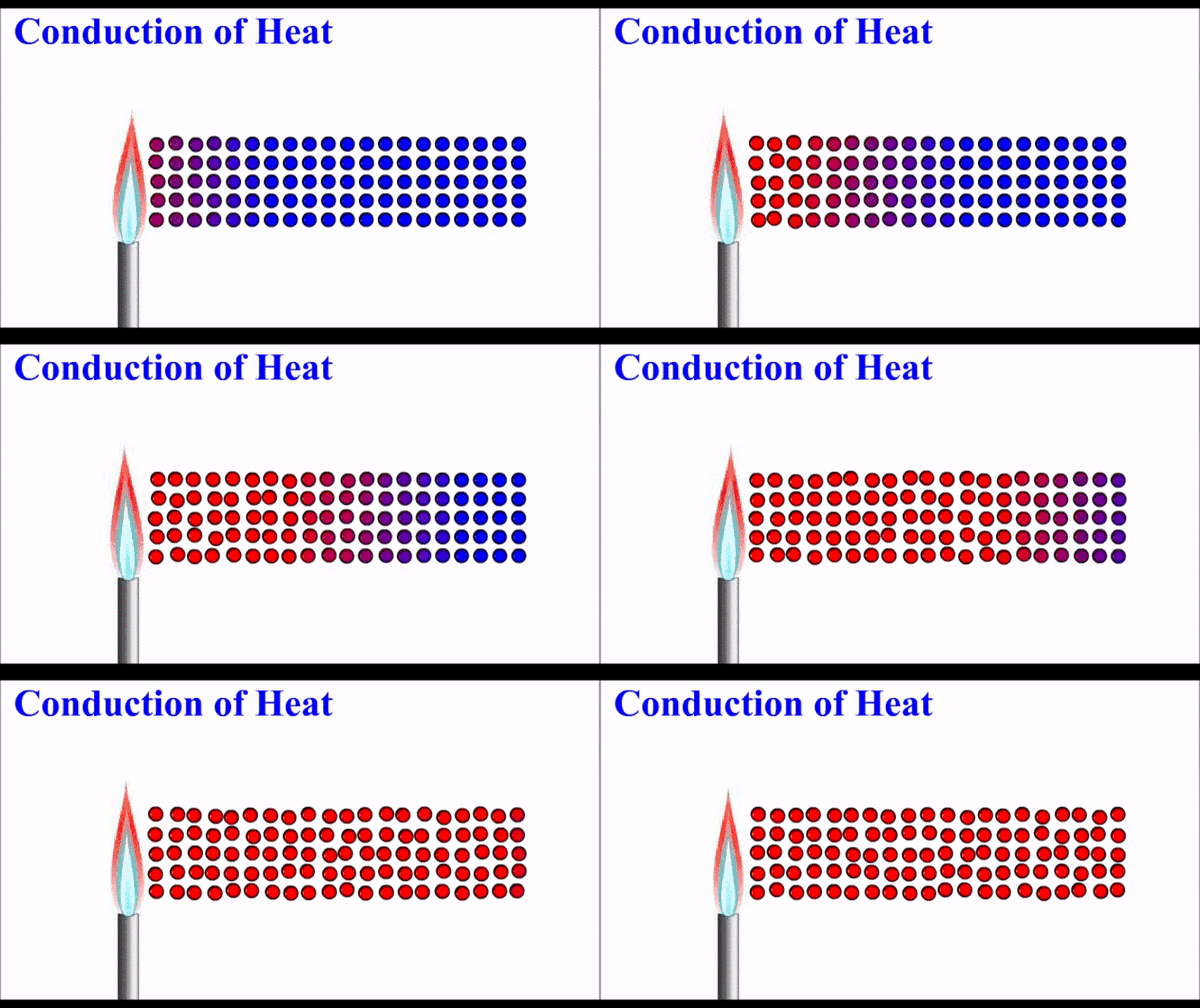
Conduction is quantified as a rate of energy per time. It is dependent on a number of factors including temperature differences, size parameters, and a material property called the thermal conductivity.
$\frac{Q}{\Delta t}=\frac{k A}{L} \Delta T$
Here $\frac{Q}{\Delta t}$ is the rate of energy transfer, measured in SI units as Joules per second. On the right-hand-side of the equation: k (kappa) is a material property called the thermal conductivity, A is the cross-sectional area through which the energy is being transferred, L is the length between the hot and cold side, and $\Delta T$ represents the temperature difference between the hot and cold side. In our discussion we will assume that the hot and cold sides stay at a constant temperature, making the situation in what's called Steady State - which simply means the rate of transfer is constant. An example is maintaining your house at 293 K while the outside maintains 278 K and energy is transfer through the window via conduction. Here A would be the area of the window, L would be the thickness of the glass, k you would look up for glass, and $\Delta T$ would be 293 K minus 278 K, or 15 K.
Convection: Thermal energy, which is a measure of motional energy of microscopic particles, can also be transferred when a higher energy particle physically moves from a higher energy to a lower energy location. In doing so they will have decreased the thermal energy in the hotter location and increased the thermal energy in the colder location. This physical transfer of mass from one location to another is called convection and is the most prevalent form of energy transfer in a gas.
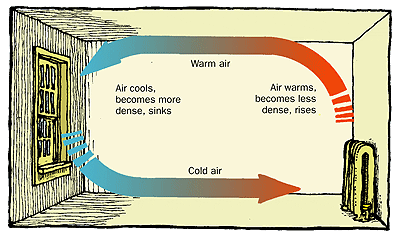
Quantifying convection requires the use of the calculus, which is beyond the scope of this discussion, so conceptual understanding is key. It's important to be able to identify when convection is present and describe the mechanism in terms of particles moving from one location to another.
Radiation: All objects with a temperature greater than 0 K, so all objects... even deep space is around 4 K, radiate electromagnetic energy.
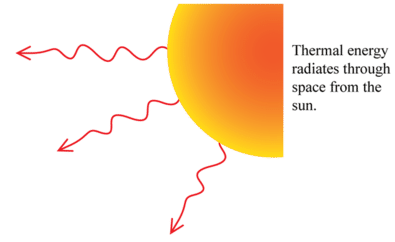
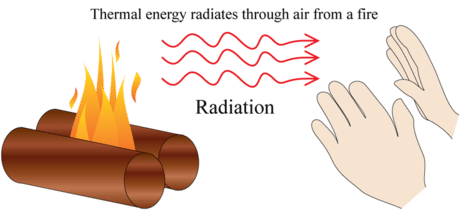
A full blown understanding of this phenomena requires deeper physics (quantum mechanics) than is the scope of our discussion here. But even if we can't understand all the underlying mechanisms, we can still quantify the results. As with conduction, radiation is cast in terms of a rate of energy transfer.
$\frac{Q_{out}}{\Delta t} = \epsilon \sigma A T^4$
In this equation $\epsilon$ is called the emissivity of the object and can be thought of as a material property. $\sigma$ is a constant called Stefan-Boltzmann's constant. A is the surface area of the object and T is the temperature of the object. It's important to note that T must be in Kelvin in this equation. Notice also that the equation says $Q_{out}$, that's because this is the radiation from the object to its environment. But what if the environment also has temperature, like it most definitely will? You must then account for what radiation also comes in to your system - you must find the net radiation in and out to get a complete picture of the change in energy per time. So, the net radiation looks like this:
$\frac{Q_{net}}{\Delta t} = \epsilon \sigma A (T^4-T_e^4)$, where $T_e$ represents the temperature of the environment
Notice that if the object and its environment have the same temperature, the net thermal radiation is zero - just as much energy leaves as enters the object.
Videos
Pre-Lecture Videos
- Conduction (4min)
- Convection (2min)
- Radiation (4min)
Supplemental but suggested
Lecture Notes | (PDF)(OneNote)
Web Resources
Text
The openstax text covers Conduction in section 14.5, Convection in 14.6 and Radiation in 14.7

The methods of Heat Transfer section on Boundless covers conduction, convection and radiation.

The Heat Transfer section of Hyperphysics also has their usual brand of concise information.
Physic Classroom's section which covers heat transfer methods.
This site gives a fairly compact view of heat transfer

Other Resources
This link will take you to the repository of other content related resources .

Videos
Here is a nice a clear explanation of heat transfer by conduction, convection, and ratiadion.
Khan Academy uses a qualitative approach to explain conduction, convection, and radiation.
A nice video covering of the three methods of Heat Transfer, done by a couple of 8th graders!
A wonderful song(to the tune of Demons by Imagine Dragons) about Conduction, Convection and Radiation
Other Resources
This link will take you to the repository of other content related resources .
Simulations
This simulation will Help you visualize the different heat transfer methods.

For additional simulations on this subject, visit the simulations repository.

Demos
For additional demos involving this subject, visit the demo repository

Practice
Fundamental examples
1. Sally places a rod of copper with cross-sectional area $A=0.5 {cm}^2$ and length = $1m$ such that one end is touching hot coals at a temperature $T_H = 600K$ and the other is in a bucket of ice at $T_c = 273K$. What is the rate of heat transfer through the rod? What mechanism of heat transfer is this?
2. Sally removes the rod from the fire and uses a digital thermometer to read its temperature. A few seconds later, she measures the temperature again and realizes it has dropped. From this she infers that the rod is at a higher temperature than the room. Assuming the rod is a black-body radiator, what is the rate of heat transfer due to radiation if the rod is at a temperature of $T_{cu}=450 K$ and the room is at a temperature of $T_{room}= 300 K$?
3. Jimmy baked some pizza and now the inside of his oven is at 600 °F . He wans to cool it down to 325 °F so that he can bake some cupcakes. Jimmy thinks he should place a fan in front of the oven to help it cool down, but Jimmy's friend Tony says that, since the oven is at such a higher temperature than its environment (600 °F versus 70 °F in the room), thermal radiation will qiuckly cool down the oven. If the goal is to cool the oven as quickly as possible do you agree with Jimmy or Tony, and why?
Short foundation building questions, often used as clicker questions, can be found in the clicker questions repository for this subject.

Practice Problems
BoxSand's multiple select problems
BoxSand's quantitative problems
Recommended example practice problems
- Openstax problems are located towards the bottom of the page.
- 14.5 Conduction Website Link.
- 14.6 Convection Website Link.
- 14.7 Radiation Website Link.
- A good quiz to practice identifying heat transfer methods, Website Link
For additional practice problems and worked examples, visit the link below. If you've found example problems that you've used please help us out and submit them to the student contributed content section.


 |
 |