Conduction, Convection, and Radiation: Tips & Tricks
Conduction, Convection, and Radiation: Tips & Tricks
Problem Solving Guide
Algorithm
For problems in this section, the crux of the problem is typically understanding which heat mechanism is involved, which means reading the prompt very carefully. There are certain key words and situations to look for:
- If a problem is discussing a solid object (a metal rod; a wooden floor) that is changing temperatures, it is likely a conduction problem.
- If a problem is talking about gas flow from one area to another (air conditioning; indoor heating), it is likely a convection problem.
- If a problem is discussing heat flow between seemingly disconnected systems (such as the Earth being isolated, via the vacuum of space, from our sun), it is likely a radiation problem.
Note that we only have quantitative equations for conduction and radiation, so any problems involving convection in this section will be qualitative (such as discussing the mechanism by which a space-heater is able to warm up a dorm room).
For conduction problems, you will use the equation
$\frac{Q}{\Delta t} = \frac{kA}{L}\Delta T$
where the left-hand-side is the rate of energy transfer, $A$ and $L$ are geometric terms (the cross-sectional area and length of the object in question), $\Delta T=T_f - T_i$, and $k$ is a constant. Take an inventory of which of these quantities you know and which you don't. You will typically be given the geometric terms, although sometimes they will be given in terms of something like a radius or diameter, in which case you'll have to do a quick calculation; remember that $\pi r^2 = \pi \left( \frac{d}{2} \right)^2 = A$ for circular cross-sections.
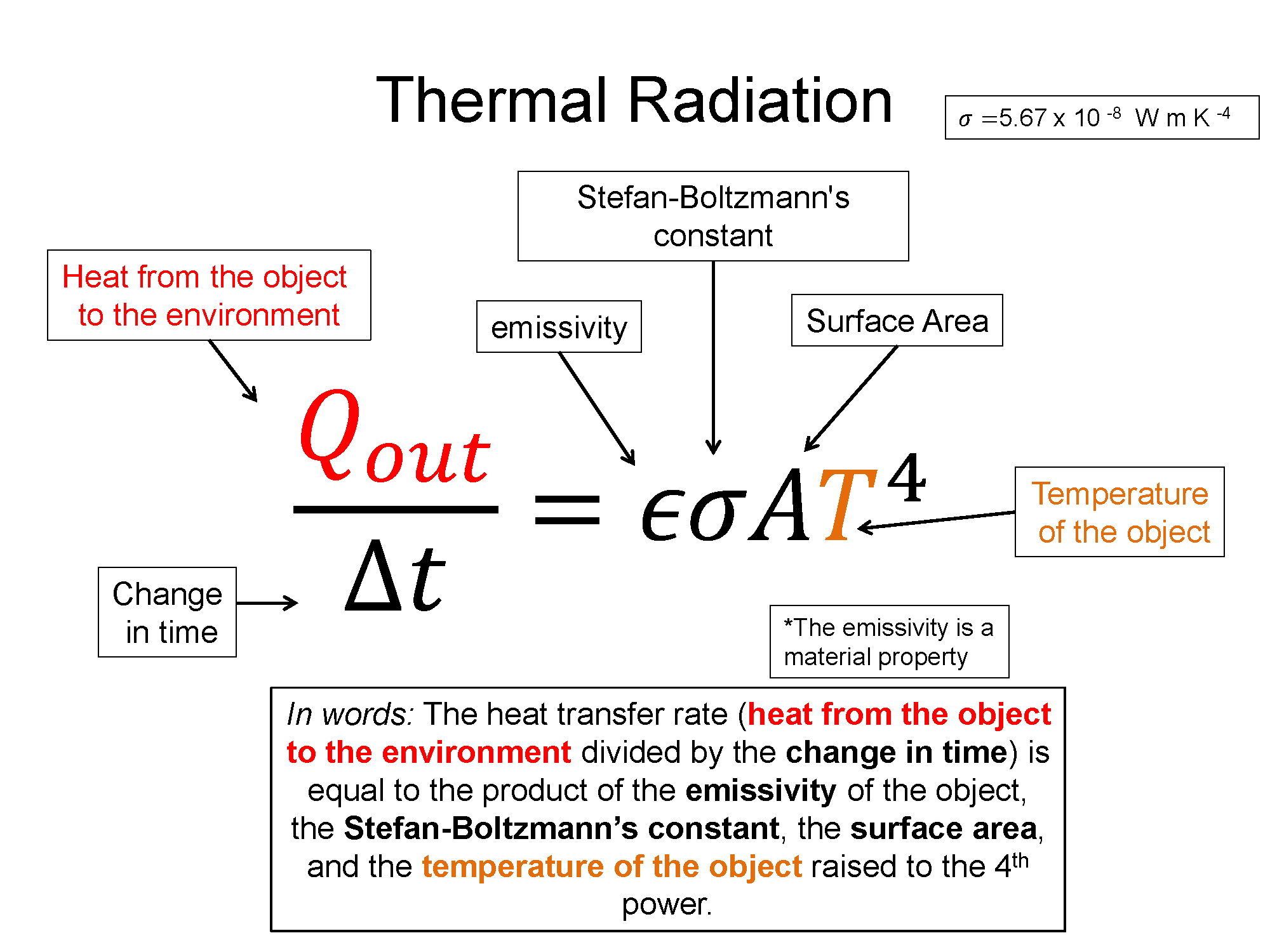
The equation that represents radiative heat transfer from one object to its environment is
$\frac{Q_{net}}{\Delta t}= \epsilon \sigma A T^4$
where $\epsilon$ and $\sigma$ are constants, $A$ the surface area of the object, and $T$ is the temperature of the object in question. Note that, while $A$ might be a cross-sectional area for conduction and a surface area for radiation, it serves the same purpose: in both cases, $A$ represents the surface or window through which thermal energy is being transferred.
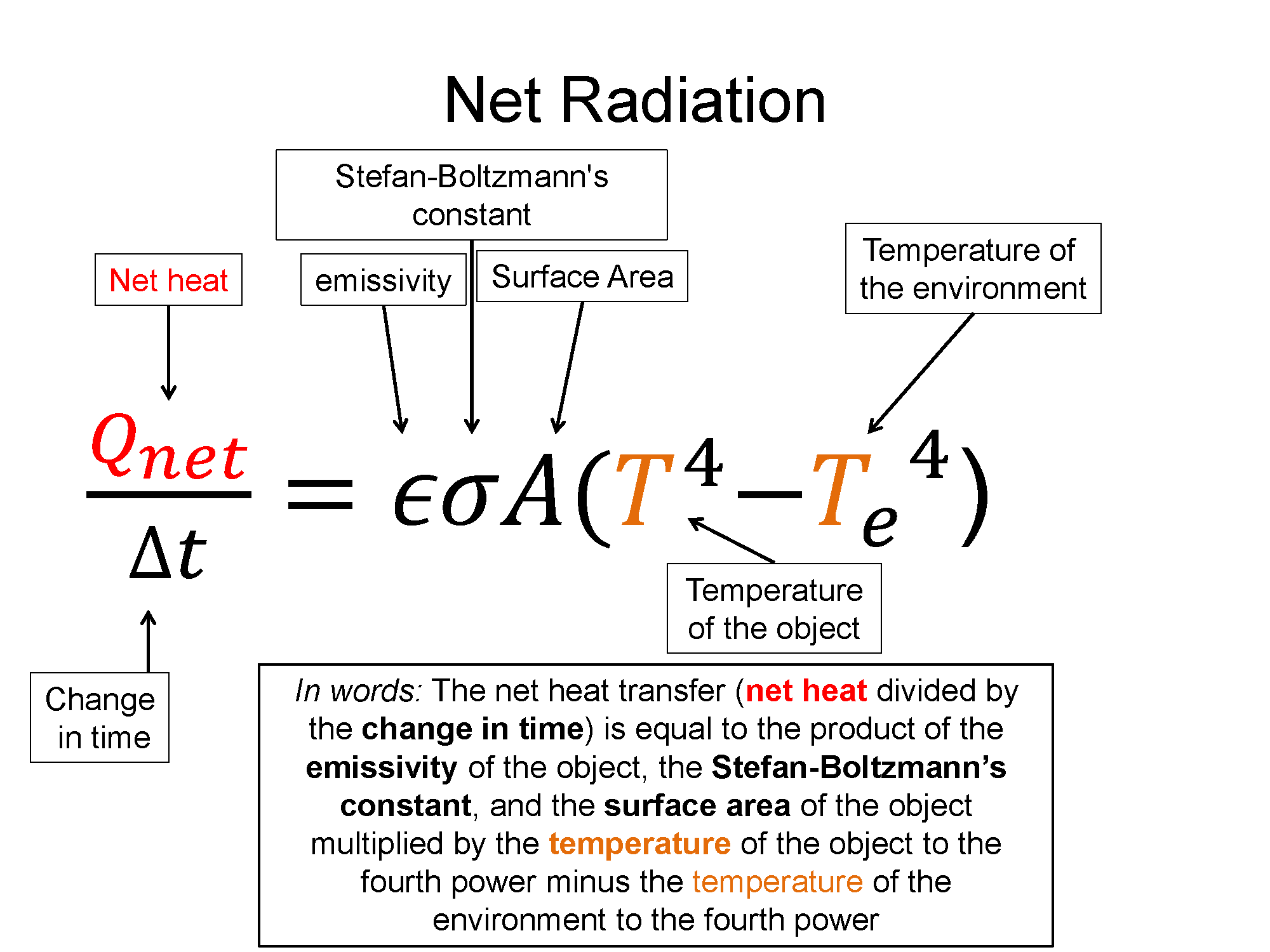
For a lot of problems, you will be asked about the heat transfer between two systems, so the equation will look like $\frac{Q_{net}}{\Delta t}= \epsilon \sigma A (T_{1}^4 - T_{2}^4) $.
Misconceptions & Mistakes
Pro Tips
Notice in the equation for radiative heat transfer:
$\frac{Q_{net}}{\Delta t} = \epsilon \sigma A(T^4 - T_{e}^4)$
the temperatures of the system and environment are individually cubed before you find the difference between the two values. Do not make the mistake of thinking that $T_{1}^4 - T_{2} ^4 = (T_1 - T_2) ^4$. If you're not convinced, plug in some sample numbers and try to convince yourself, or try expanding out each term the same way you would expand out $(a - b)^2$.
Note that, while $A$ might be a cross-sectional area for conduction and a surface area for radiation, it serves the same purpose: in both cases, $A$ represents the surface or window through which thermal energy is being transferred.
Multiple Representations
Multiple Representations is the concept that a physical phenomena can be expressed in different ways.
Physical
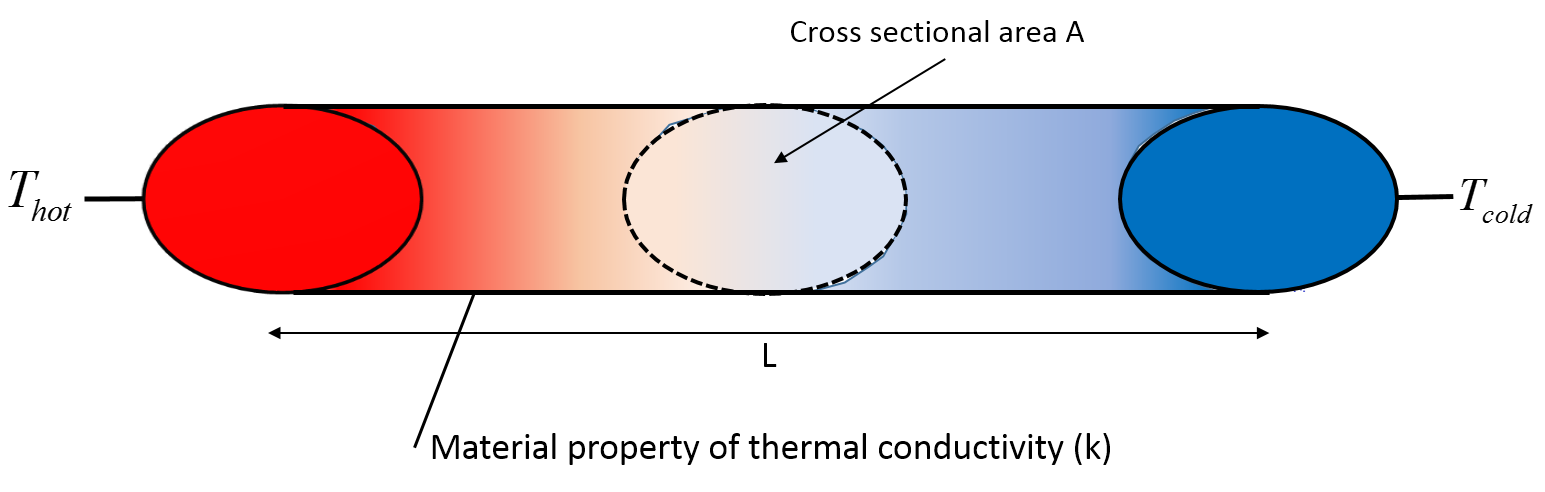
We have a tube where one end is in a hot water bath and the other in a cold water bath.
Convection
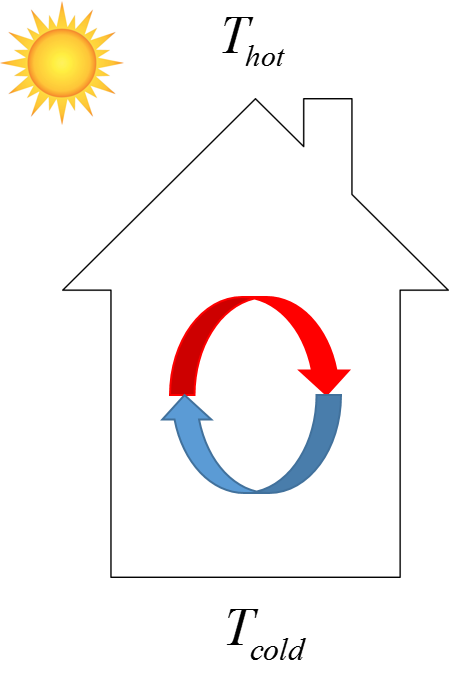
Heat from the sun is the hot reservoir and the earth that the house sits on is the cold reservoir. The difference in the two hot and cold reservoirs is a perfect system for convection.
Radiation
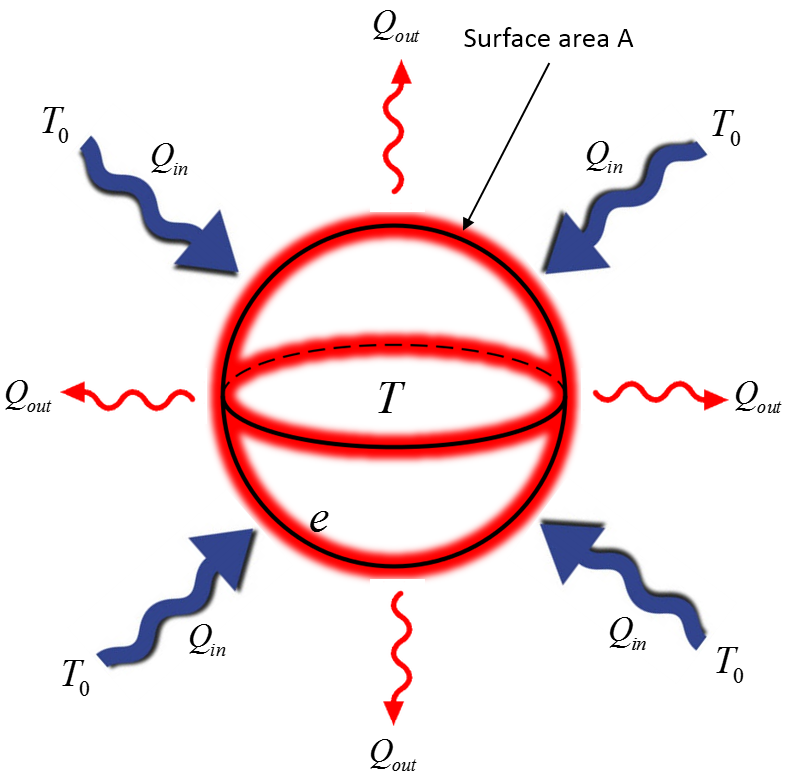
Radiation from a hot object such as the sun.
Mathematical
Conduction
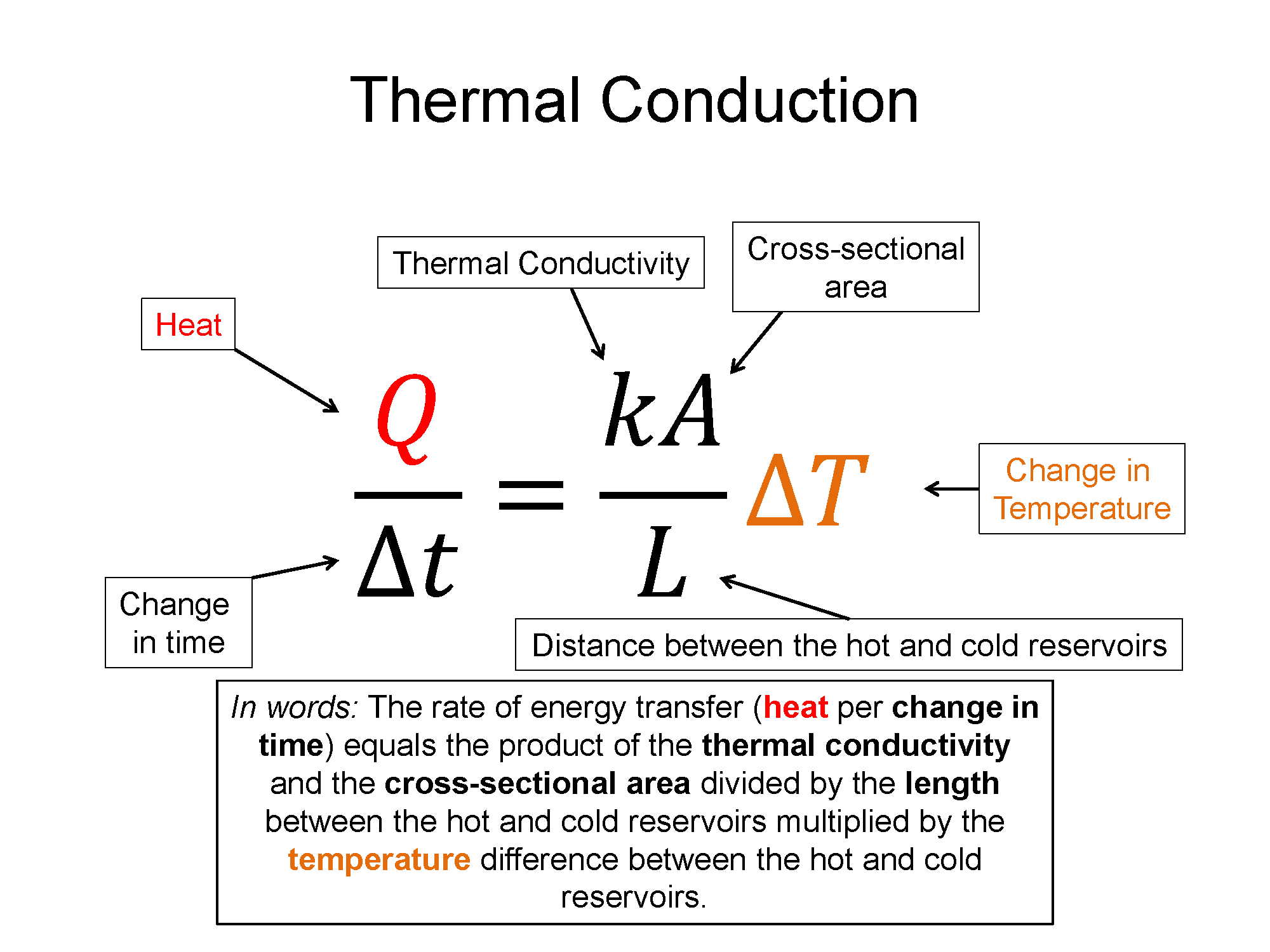
$\frac{Q}{\Delta t} = \frac{kA}{L} \Delta t$
$\frac{Q}{\Delta t} \implies \frac{Energy}{time}$
Convection
Mathematical Representation for Convection is complicated...
Radiation
$\frac{Q_{out}}{\Delta t} = e \sigma A T^{4}$, Radiation out
$\frac{Q_{in}}{\Delta t} = e \sigma A T_{0}^{4}$, Radiation in
$\frac{\sum Q}{\Delta t} = e \sigma A (T^{4}-T_{0}^{4})$, Net radiation
Graphical
Descriptive
Conduction
Molecules on the hot side of the are moving (vibrating) more than they are on the cold side. This motional energy propagates down the material via collisions with adjacent molecules. One molecule vibrates the next molecule which then vibrates the next and so on.
Convection
Faster moving hot molecules move to the slower moving cold side, increasing the average kinetic energy. This action may cause cold molecules to be pushed to the hot side creating convection currents.
Radiation
Thermal radiation consists of electromagnetic waves that carry energy away from the sources and transfer the energy to another object. A perfect example is the sun. The energy transfer to your skin via electromagnetic waves may be felt by your skin warming up.
Experimental
Conduction
Here we have an experiment that demonstrates conductivity.
Convection
Here we have an experiment that demonstrates convection.
Radiation
We can take an ice cube and set it out in the sun to observe thermal radiation. The electromagnetic waves from the sun transfer energy from the sun to the ice cube, which increases the temperature of the ice cube thus melting the ice.
 |