Charges & the Electric Force: Overview
Charges & the Electric Force: Overview
Atoms are comprised of charges. The postively charged nucleus is attracted to the negatively charged electrons. Molecules, which are comprised of atoms, also bind together due to this charge related force of attraction. Solids and liquids, comprised of molecules, also bind together due to the electric force of charges. All forces we experience, except gravity, are due to the electric force.
Crash Crouse physics introduces us to charges.
Big Ideas
Big Idea 1: Objects and systems have properties such as mass and charge. Systems may have internal structure.
Bid Idea 2: Fields existing in space can be used to explain interactions.
Big Idea 3: The interactions of an object with other objects can be described by forces.
Big Idea 4: Interactions between systems can result in changes in those systems.
Learning Objectives
BoxSand Learning Objectives
Electric-Fields-Potentials.Charges-Force.LO.BS.1: Be able to determine the net force on a charge due to other charges
Electric-Fields-Potentials.Charges-Force.LO.BS.2: Be able to find equilibrium locations for a set of charges
Electric-Fields-Potentials.Charges-Force.LO.BS.3: Be able to identify the features of both insulators and conductors
Electric-Fields-Potentials.Charges-Force.LO.BS.4: Be able to follow where the charges reside when charge transfers occur
Electric-Fields-Potentials.Charges-Force.LO.BS.5: Students should understand the concept of electric charge, so they can:
- Describe the types of charge and the attraction and repulsion of charges.
- Describe polarization and induced charges.
Electric-Fields-Potentials.Charges-Force.LO.BS.6: Students should understand Coulomb’s Law and the principle of superposition, so they can:
- Calculate the magnitude and direction of the force on a positive or negative charge due to other specified point charges.
- Analyze the motion of a particle of specified charge and mass under the influence of an electrostatic force.
College Board Learning Objectives
Electric-Fields-Potentials.Charges-Force.LO.CB.1.B.1.1: The student is able to make claims about natural phenomena based on conservation of electric charge. [SP 6.4]
Electric-Fields-Potentials.Charges-Force.LO.CB.1.B.1.2: The student is able to make predictions, using the conservation of electric charge, about the sign and relative quantity of net charge of objects or systems after various charging processes, including conservation of charge in simple circuits. [SP 6.4, 7.2]
Electric-Fields-Potentials.Charges-Force.LO.CB.1.B.2.1: The student is able to construct an explanation of the two-charge model of electric charge based on evidence produced through scientific practices. [SP 6.2]
Electric-Fields-Potentials.Charges-Force.LO.CB.1.B.2.2: The student is able to make a qualitative prediction about the distribution of positive and negative electric charges within neutral systems as they undergo various processes. [SP 6.4, 7.2]
Electric-Fields-Potentials.Charges-Force.LO.CB.1.B.2.3: The student is able to challenge claims that polarization of electric charge or separation of charge must result in a net charge on the object. [SP 6.1]
Electric-Fields-Potentials.Charges-Force.LO.CB.1.B.3.1: The student is able to challenge the claim that an electric charge smaller than the elementary charge has been isolated. [SP 1.5, 6.1, 7.2]
Electric-Fields-Potentials.Charges-Force.LO.CB.3.C.2.1: The student is able to use Coulomb’s law qualitatively and quantitatively to make predictions about the interaction between two electric point charges. [SP 2.2, 6.4]
Electric-Fields-Potentials.Charges-Force.LO.CB.3.C.2.2: The student is able to connect the concepts of gravitational force and electric force to compare similarities and differences between the forces. [SP7.2]
Electric-Fields-Potentials.Charges-Force.LO.CB.3.C.2.3: The student is able to use mathematics to describe the electric force that results from the interaction of several separated point charges (generally 2 to 4 point charges, though more are permitted in situations of high symmetry). [SP 2.2]
Electric-Fields-Potentials.Charges-Force.LO.CB.3.G.1.2: The student is able to connect the strength of the gravitational force between two objects to the spatial scale of the situation and the masses of the objects involved and compare that strength to other types of forces. [SP7.1]
Electric-Fields-Potentials.Charges-Force.LO.CB.3.G.2.1: The student is able to connect the strength of electromagnetic forces with the spatial scale of the situation, the magnitude of the electric charges, and the motion of the electrically charged objects involved. [SP 7.1]
Electric-Fields-Potentials.Charges-Force.LO.CB.5.C.2.1: The student is able to predict electric charges on objects within a system by application of the principle of charge conservation within a system. [SP6.4]
Electric-Fields-Potentials.Charges-Force.LO.CB.5.C.2.2: The student is able to design a plan to collect data on the electrical charging of objects and electric charge induction on neutral objects and qualitatively analyze that data. [SP4.2, 5.1]
Electric-Fields-Potentials.Charges-Force.LO.CB.5.C.2.3: The student is able to justify the selection of data relevant to an investigation of the electrical charging of objects and electric charge induction on neutral objects. [SP 4.1]
Enduring Understanding and Essential Knowledge
|
Enduring Understanding |
Essential Knowledge |
|
Electric-Fields-Potentials.Charges-Force.EU.CB.1.B: Electric charge is a property of an object or system that affects its interactions with other objects or systems containing charge. |
Electric-Fields-Potentials.Charges-Force.EK.CB.1.B.1: Electric charge is conserved. The net charge of a system is equal to the sum of the charges of all the objects in the system.
Relevant Equations: $I=\frac{\Delta Q}{\Delta t}$ Electric-Fields-Potentials.Charges-Force.EK.CB.1.B.2: There are only two kinds of electric charge. Neutral objects or systems contain equal quantities of positive and negative charge, with the exception of some fundamental particles that have no electric charge.
1.B.3: The smallest observed unit of charge that can be isolated is the electron charge, also known as the elementary charge.
|
|
Electric-Fields-Potentials.Charges-Force.EU.CB.3.C: At the macroscopic level, forces can be categorized as either long-range (action-at-a-distance) forces or contact forces. |
Electric-Fields-Potentials.Charges-Force.EK.CB.3.C.2: Electric force results from the interaction of one object that has an electric charge with another object that has an electric charge.
Relevant Equations: $F_{E}=\frac{1}{4 \pi \epsilon_{0}} \frac{q_{1}q_{2}}{r^{2}} $ $F_{G} = \frac{G m_{1} m_{2}}{r^{2}}$ |
|
Electric-Fields-Potentials.Charges-Force.EU.CB.3.G: Certain types of forces are considered fundamental. |
Electric-Fields-Potentials.Charges-Force.EK.CB.3.G.1: Gravitational forces are exerted at all scales and dominate at the largest distance and mass scales. Relevant Equations: $F_{G} = \frac{G m_{1} m_{2}}{r^{2}}$ Electric-Fields-Potentials.Charges-Force.EK.CB.3.G.2: Electromagnetic forces are exerted at all scales and can dominate at the human scale. Relevant Equations: $F_{E}=\frac{1}{4 \pi \epsilon_{0}} \frac{q_{1}q_{2}}{r^{2}} $ |
|
Electric-Fields-Potentials.Charges-Force.EU.CB.5.C: The electric charge of a system is conserved. |
Electric-Fields-Potentials.Charges-Force.EK.CB.5.C.2: The exchange of electric charges among a set of objects in a system conserves electric charge.
|
Assumptions
Describe what the assumptions are and why they're important
 |
 |
History
History
Physics Fun
Surface tension is a polarization force between atoms. It's responsible for holding a water droplet together.

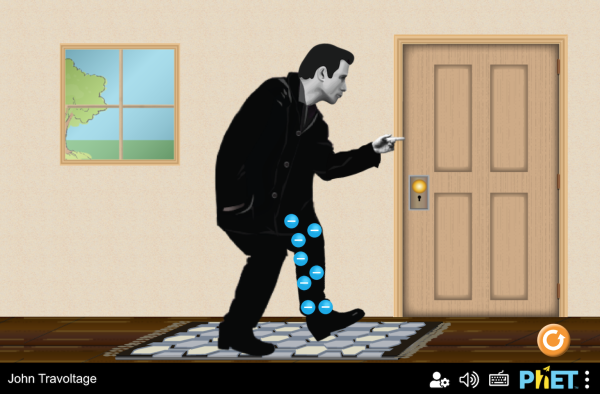
Play with John Travolta's leg and arm to get a Travoltage.
 |