Hydrostatics: Fundamentals
Hydrostatics: Fundamentals
BoxSand's Resources
Introduction
Pressure at a depth
Have you ever gone swimming in a really deep body of water? If so, you are probably familiar with the sensation you get when diving down to very deep depths below the surface of the water. This sensation is a result of your inner ears letting you know the pressure of the water around you is increasing. How can we mathematically show this pressure increase as we go deeper into the water, also referred to as “pressure at a depth”?
Consider a container of water open to the atmosphere at the top as shown in the figure below.
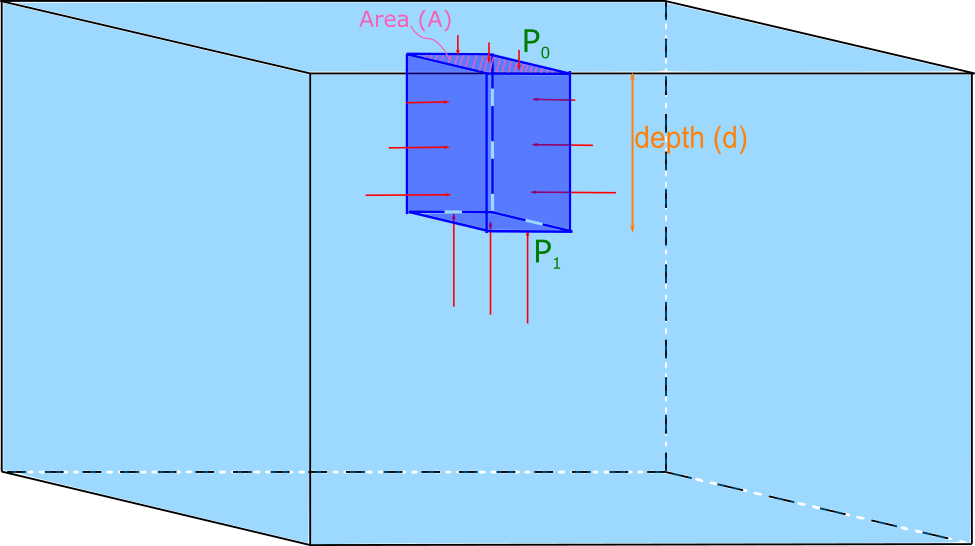
Let the density of the water be $\rho_f$. Now imagine a smaller rectangular volume element of water in the container as indicated by slightly darker blue. The downward force on this volume element of water at the top of the surface is due to the atmospheric pressure $P_0$ multiplied by the area $A$ of the top of the volume element. Since this volume of water is stationary, (i.e. it is not accelerating), we know that there must be an upward force at the bottom of the volume element which is greater than the top force because it must also support the weight of the volume element. This statement is analgous to the following situation: 5 books are stacked on top of each other, the top book has a normal force acting on it upwards from the second from the top equal to the weight of the top book only, while the book on the bottom of the stack has a normal force acting on it upwards from a table equal to the combined weight of all 5 books. There are also forces from the pressure on either side (left, and right) of the volume element which must be equal to each other because the volume element is not accelerating in either direction. The descriptive representation of this scenario is nicely visualized with an accompanying FBD for the volume element of water as shown below. (The horizontal forces are not shown since they all cancel out.)
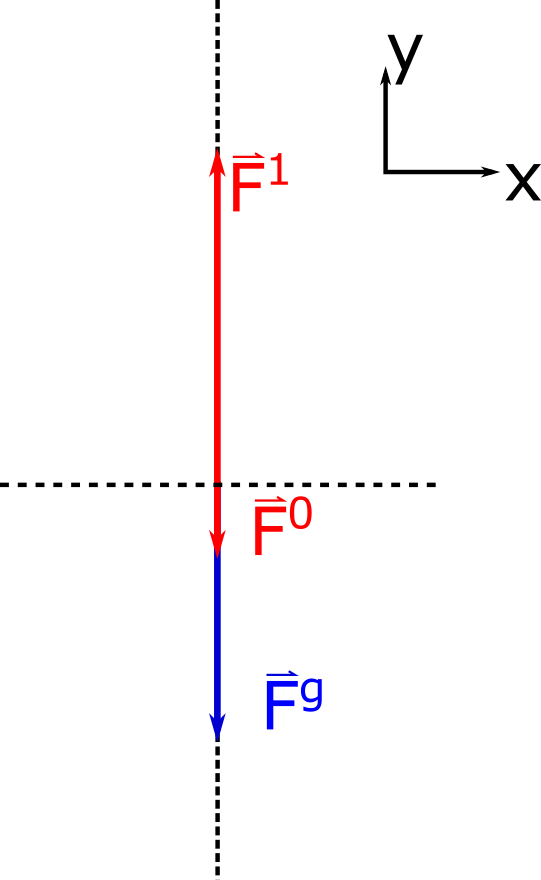
Using Newton's second law we can translate our physical representation (FBD) into a mathematical representation as shown below.
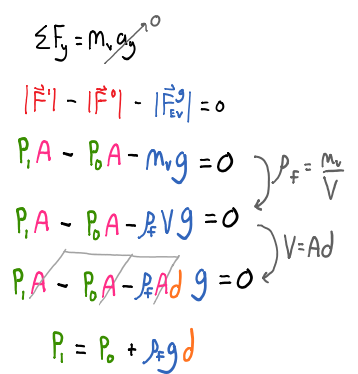
Notice the end result for the pressure at the bottom of the volume element is not dependent on the area or volume, it only depends on the depth below the surface $d$, the density of the fluid $\rho_f$, the acceleration due to gravity caused by the planet the body of fluid is near $g$, and the pressure above the surface of the fluid $P_0$.
*NOTE: Our analysis of pressure at a depth used the assumption that the fluid is incompressible (i.e. the fluid has a constant density). This is a good assumption for liquids like water that do not compress much. In contrast, the atmosphere is still considered a fluid, but it is a gas which is easily compressible, thus our pressure at a depth analysis is only valid for very small depths.
Pascal's law
Pascal's law is formally stated as follows, "for an incompressible and enclosed fluid, a change in pressure at one location results in the same change in pressure, without a diminish in magnitude, at all locations within the enclosed fluid and walls".
Consider the analysis we did in the "pressure at a depth" section above. If the pressure $P_0$ above the surface of the water increases by some amount $\Delta P$ so that the new pressure above the surface is now $P^{'}_{0} = P_0 + \Delta P$, then the pressure at all locations within the fluid also increase by the same amount $\Delta P$. Thus the pressure at the bottom of the volume element would be $P_1 + \Delta P = P_0 + \rho_{f} \, g \, d + \Delta P$.
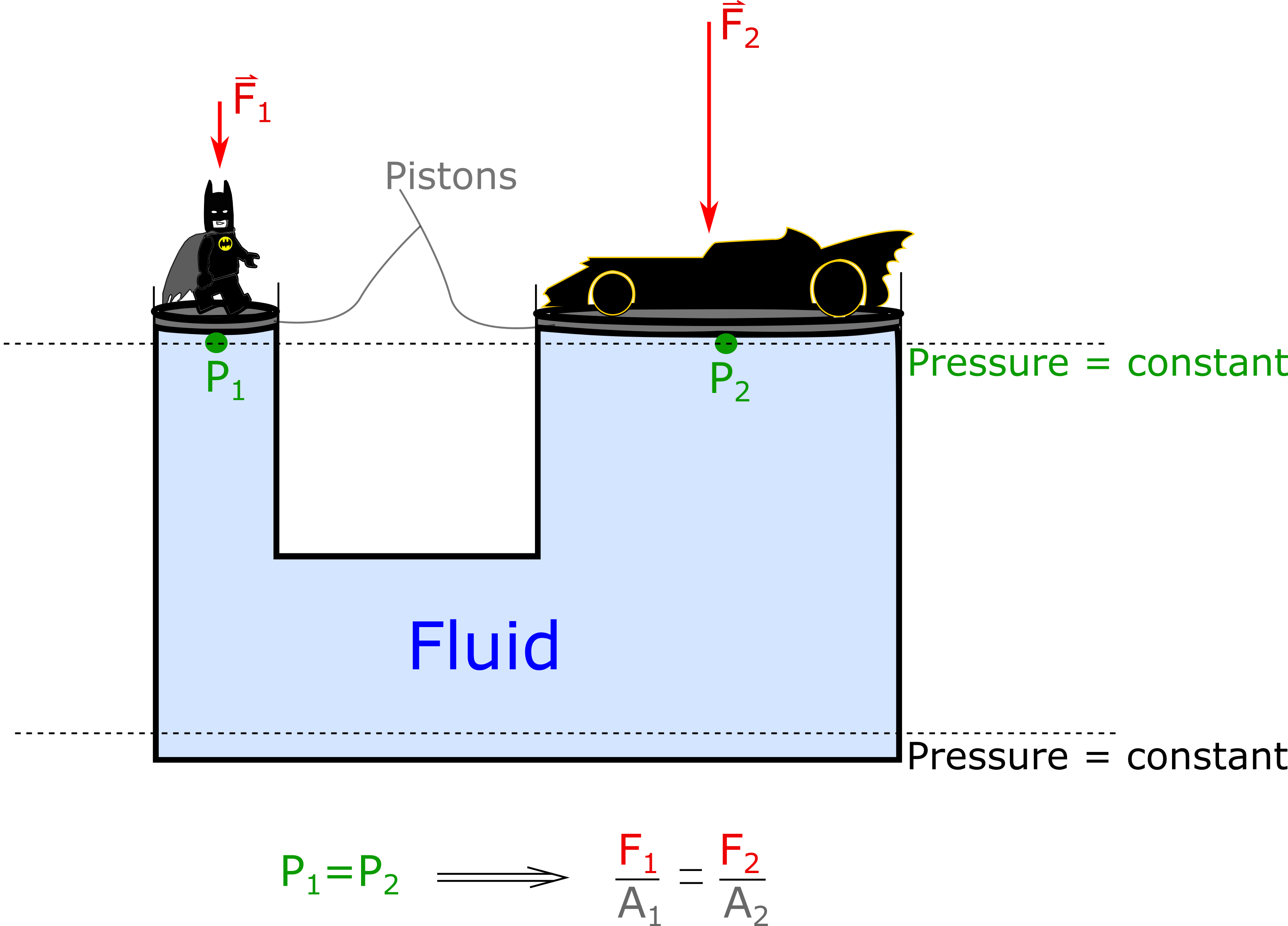
Hydraulic brakes and lifts generally work by applying a force over an area at one location which increases the pressure at that location along with all other locations in the system. Thus hydraulics are an interesting application of Pascal's law. Below is a figure illustrating a simplified hydraulic lift.
Videos
Pre-lecture Videos
- hydrostatic pressure(8min)
- hydrostatic pressure and Pascal(3min)
- hydrostatic pressure mechanical advantage(8min)
Supplemental but suggested
- hydrostatic pressure simple example(3min)
- hydrostatic pressure example two separate fluids(3min)
- gauge pressure(2min)
- hydrostatic pressure example mechanical advantage(5min)
- hydrostatic pressure example mechanical advantage lever(6min)
Lecture Notes | (PDF)(OneNote)
Web Resources
Text
This section of the Openstax text covers variation of pressure with depth.

This section of the Openstax text covers gauge Pressure and Absolute Pressure.

Boundess sections on variation of pressure with depth

and gauge pressure
Hyperphysics section on Pascal's Principle and hydraulic press.

More openstax, this time covering the mechanical advantage of a hydraulic lift
Other Resources
This link will take you to the repository of other content related resources .

Videos
Lecture on Hydrostatic equilibrium
Good example problem involving hydrostatics
Other Resources
This link will take you to the repository of other content related resources .
Simulations
This PhET simulation lets you view pressure at different areas in the system, and change the water levels. As well as mess with fun stuff like gravity and fluid density.

For additional simulations on this subject, visit the simulations repository.

Demos
For additional demos involving this subject, visit the demo repository

Practice
Fundamental examples
1. Crater Lake is the deepest lake in the United States with a maximum depth of about $593 \, m$. The surface of the lake is roughly $6,000 \, ft$ above sea level which means the standard atmospheric pressure at the surface is approximately $81 \, kPa$.
(a) What is the pressure at the deepest part of Crater Lake?
(b) What is the pressure halfway between the deepest part and the surface of Crater Lake?
2. A cylindrical container that is open to the standard atmosphere contains two different fluids of densities $\rho_{a} = 890 \, kg/m^3$ and $\rho_{b} = 1000 \, kg/m^3$ as seen in the figure below. The depths of each fluid are labeled on the figure. What is the pressure at the bottom of the container?

3. A container that is open to the atmosphere at one end and closed on the other contains a liquid of density $\rho = 890 \, kg/m^3$ as shown in the figure below. The open end has a diameter of $0.25 \, m$ and the closed end diameter of $0.5 \, m$.

(a) What is the pressure at locations labeled $P_1$ and $P_2$?
(b) If a piston is then inserted into the open end and applies an additional force of $500 \, N$, what is the new pressure at the locations $P_1$ and $P_2$?
CLICK HERE for solutions.
Short foundation building questions, often used as clicker questions, can be found in the clicker questions repository for this subject.

Practice Problems
BoxSand practice problems
Conceptual problems
BoxSand's quantitative problems
Recommended example practice problems
- Openstax sections have practice problems at the bottom,
- Variation of Pressure with Depth, Website Link
- Gauge Pressure, Absolute Pressure, Website Link
- A few questions on pressure with depth, Website Link
- 4 problem worksheet on hydrostatic pressure, PDF Link
For additional practice problems and worked examples, visit the link below. If you've found example problems that you've used please help us out and submit them to the student contributed content section.


 |
 |